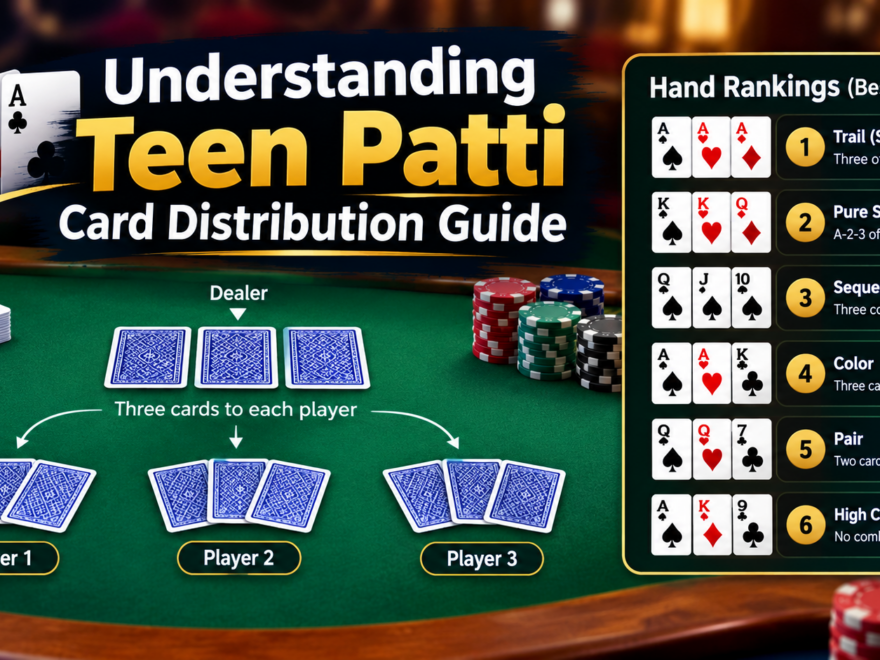
Teen Patti is a three-card game where understanding how cards are distributed is just as important as knowing the hand rankings. At first glance, the dealing process seems simple: shuffle the deck, give each player three cards, and begin the round. However, the way those cards are distributed creates the foundation for every decision that follows.
For anyone getting familiar with Teen Patti, understanding the card distribution process can make the game much easier to follow. It helps players understand why certain combinations are uncommon, how hand strength is formed, and why every new deal creates a fresh set of possibilities.
How Cards Are Distributed in Teen Patti
Classic Teen Patti is generally played with a standard 52-card deck without Jokers. The deck contains four suits and 13 ranks in each suit.
Before the deal begins, players normally contribute the agreed boot amount to the pot. The dealer then shuffles the deck and distributes three cards to each active player. The cards are normally dealt face down, one at a time, around the table.
For example, if four players are participating, the dealer will distribute 12 cards in total:
- Player 1 receives three cards
- Player 2 receives three cards
- Player 3 receives three cards
- Player 4 receives three cards
The remaining cards stay unused for that particular hand.
The important point is that each player’s three-card combination is formed from the same shuffled deck. This means the exact cards received by one player affect which cards remain available to everyone else.
Why the Distribution Process Matters
Card distribution determines the possible hands players can receive. Since each player gets only three cards, even a small change in the cards dealt can completely change the strength of a hand.
The standard hand hierarchy moves from Trail or Trio at the top through Pure Sequence, Sequence, Colour, Pair and High Card.
For example, receiving three cards of the same rank creates a Trail, while three consecutive cards of the same suit create a Pure Sequence. A Pair requires two cards of the same rank.
This is why understanding distribution is useful. Players are not simply receiving random cards; they are receiving a small combination from a defined 52-card pool.
The Six Main Teen Patti Hands
Once the cards have been distributed, players need to understand how their three-card combination is classified.
1. Trail or Trio
A Trail consists of three cards with the same rank, such as A-A-A or 8-8-8. Three Aces are generally considered the strongest Trail.
Because there are only four cards of each rank in a standard deck, receiving three cards of the same rank is relatively uncommon.
2. Pure Sequence
A Pure Sequence consists of three consecutive cards from the same suit. For example, 9♥, 8♥ and 7♥ form a Pure Sequence.
The exact treatment of Ace sequences can differ between versions, so players should always check the rules of the specific table or platform they are using.
3. Sequence
A Sequence contains three consecutive cards that are not all from the same suit. For example, 8♠, 7♥ and 6♦ can form a Sequence.
4. Colour
A Colour means three cards from the same suit that do not form a sequence. A hand such as A♣, J♣ and 6♣ is an example.
When two players have the same category, the individual card values are normally compared to determine the stronger hand.
5. Pair
A Pair contains two cards of the same rank and one different card. For instance, K♠, K♥ and 5♦ form a Pair.
The rank of the pair is considered first when comparing two Pair hands.
6. High Card
If the three cards do not form any of the combinations above, the hand is classified as a High Card hand.
The highest card is compared first, followed by the next highest when necessary.
Blind and Seen Play After Distribution
Card distribution is also connected to one of Teen Patti’s most recognizable features: Blind and Seen play.
A player who has not looked at their cards is playing Blind. A player who has looked at their cards is playing Seen. The betting requirements can differ between the two, depending on the rules being used.
This creates an interesting part of the game. A player may decide how to continue betting without knowing their cards when playing Blind, while a Seen player can make decisions with information about their actual three-card hand.
The distribution itself remains random, but the decision about whether to look at the cards adds another layer to the round.
Understanding the Probability Behind Three Cards
There are 22,100 possible three-card combinations that can be selected from a 52-card deck when the order of the cards is ignored. This helps explain why some Teen Patti hands appear much more frequently than others.
High Card combinations make up the largest portion of possible three-card hands, while Trails and Pure Sequences are much less common.
That does not mean a player can predict the next deal. A properly shuffled deck does not remember previous hands, and past results do not guarantee what will happen in the next round.
Instead, probability is useful for understanding why different hand categories have different levels of rarity.
Card Distribution and Online Teen Patti
Online Teen Patti follows the same basic concept of giving each active player three cards, although the actual dealing is handled digitally rather than by a physical dealer.
For players interested in different Teen Patti formats, it is important to check the rules of the individual game before starting. Some platforms may offer variations that change the standard hand rankings, introduce special cards, or modify the betting structure.
A platform such as CricBet99 can also be relevant for readers looking at broader online betting and gaming categories, but players should always review the specific game rules and applicable terms before participating.
Common Mistakes to Avoid
New players often focus heavily on betting while overlooking the fundamentals of card distribution.
Some common mistakes include:
- Forgetting that each player receives only three cards
- Confusing a Sequence with a Pure Sequence
- Assuming every table uses exactly the same Ace rules
- Not checking the specific rules of a game variation
- Treating previous hands as a prediction of the next deal
- Ignoring bankroll and responsible-play limits
A strong understanding of the basics makes the game easier to follow and reduces unnecessary confusion during a round.
FAQs About Teen Patti Card Distribution
How many cards does each player receive in Teen Patti?
Each player normally receives three cards in classic Teen Patti. The cards are generally dealt face down from a standard 52-card deck.
Does Teen Patti use Jokers?
Classic Teen Patti normally uses a standard 52-card deck without Jokers. Some variations may introduce special cards, so the table rules should always be checked first.
Is the card distribution predictable?
No. When the deck is properly shuffled, the next hand cannot be reliably predicted from previous deals. Each new deal creates a new combination of possibilities.
What is the strongest Teen Patti hand?
A Trail or Trio is generally the highest-ranking standard Teen Patti hand, followed by Pure Sequence, Sequence, Colour, Pair and High Card.
Does the order of dealing affect the final hand?
The cards are distributed sequentially, but what matters for a player’s standard hand is the three cards they receive. In a properly shuffled deck, the dealing order itself does not create a predictable advantage.
Final Thought
Card distribution is the starting point of every Teen Patti hand. Once players understand how the three-card deal works, how the 52-card deck creates different combinations, and how those combinations are ranked, the rest of the game becomes much easier to understand.
The most useful approach is to learn the standard rules first, understand the difference between Blind and Seen play, and then become familiar with the common hand categories. Most importantly, remember that every deal is independent and that no card-distribution pattern can guarantee a future result. Players should always follow the rules of their chosen platform and play responsibly.