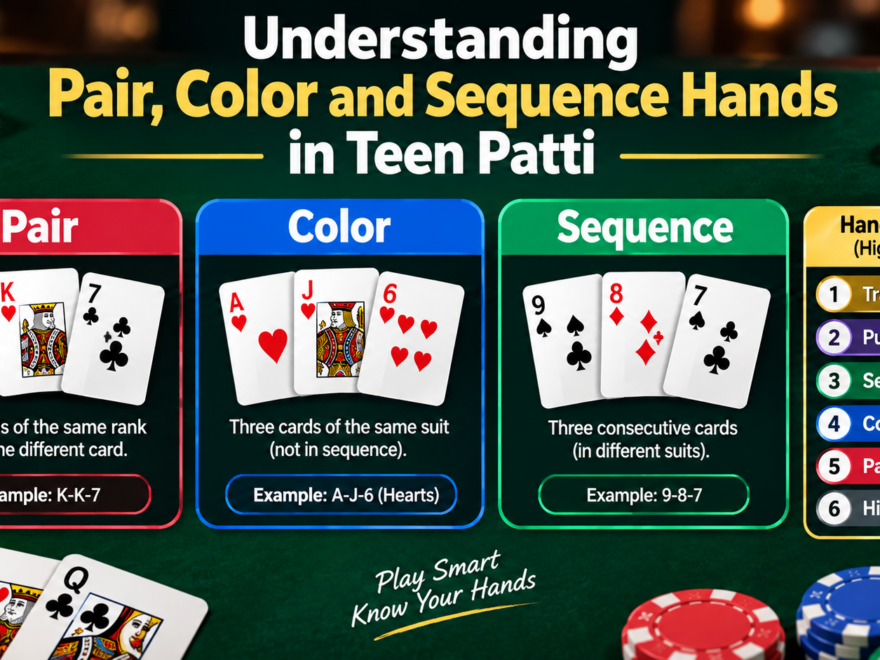
Teen Patti is a three-card game where knowing the strength of your hand is just as important as understanding the betting flow. At first, the cards may look simple, but small differences can completely change the ranking. A Pair, Color and Sequence in Teen Patti are three important hand types that every player should be able to identify quickly.
These hands are not equal in strength. A Sequence generally ranks above a Color, while a Color ranks above a Pair in the standard Teen Patti hierarchy. Understanding these differences makes it easier to compare cards at the table and avoid common mistakes.
What Are Pair, Color and Sequence Hands in Teen Patti?
In standard Teen Patti, players receive three cards from a standard 52-card deck. The objective is to have a stronger hand than the other players when the cards are compared.
The commonly used ranking from highest to lowest is:
- Trail or Trio
- Pure Sequence
- Sequence
- Color
- Pair
- High Card
This means a Sequence beats a Color, and a Color beats a Pair. The ranking of the category comes first; individual card values are considered when two players have the same type of hand.
Different Teen Patti variations and tables can have their own rules, particularly around Ace-based sequences, so checking the specific game rules is important before playing.
What Is a Pair in Teen Patti?
A Pair consists of two cards with the same rank, along with one different card.
For example:
- A-A-7
- K-K-4
- 9-9-Q
- 5-5-A
The suit of the paired cards does not matter. What matters is that two cards have the same numerical or face value.
A Pair ranks above a High Card but below a Color, Sequence and the higher-ranking hands.
How Is a Pair Compared?
When two players both have a Pair, the value of the pair is compared first.
For example:
Player A: K-K-6
Player B: Q-Q-A
Player A has the higher Pair because Kings rank above Queens. The Ace in Player B’s hand does not change the result because the Pair category is compared first.
If both players have the same Pair, the remaining card can be used as the tie-breaker under the applicable table rules.
For example:
Player A: 8-8-A
Player B: 8-8-K
Both players have a Pair of Eights, so the Ace side card beats the King.
What Is a Color in Teen Patti?
A Color, sometimes called a Flush, consists of three cards from the same suit that are not in sequence.
Examples include:
- A-J-6 of Hearts
- K-9-4 of Spades
- Q-8-3 of Diamonds
The cards need to share the same suit, but they do not need to be consecutive.
This is where beginners sometimes confuse Color with Pure Sequence. If three cards are from the same suit and also consecutive, they form a Pure Sequence rather than an ordinary Color.
For example, 8-7-6 of Hearts is a Pure Sequence, while A-J-6 of Hearts is a Color.
How Is a Color Compared?
When two players both have Color, the highest card is normally compared first. If the highest cards are equal, the next highest card is considered, followed by the third card if necessary.
For example:
Player A: A-J-6 of Hearts
Player B: K-Q-10 of Spades
Player A wins because an Ace is higher than a King.
Another example:
Player A: K-10-7 of Clubs
Player B: K-9-8 of Hearts
Both hands start with a King, so the second-highest cards are compared. The Ten gives Player A the higher Color.
What Is a Sequence in Teen Patti?
A Sequence consists of three consecutive cards. Unlike a Pure Sequence, the three cards in an ordinary Sequence do not have to belong to the same suit.
Examples include:
- 9-8-7 in different suits
- Q-J-10 in different suits
- 6-5-4 in different suits
A Sequence is stronger than a Color and a Pair in the commonly used Teen Patti ranking system.
The important distinction is that the cards must follow a consecutive order. Simply having three high cards does not make a Sequence.
For example, A-K-9 is not a Sequence because the cards are not consecutive.
Sequence vs Color vs Pair
The easiest way to remember the difference is to focus on what connects the cards.
| Hand | What It Contains | Standard Ranking |
| Sequence | Three consecutive cards | Higher |
| Color | Three cards of the same suit | Middle |
| Pair | Two cards of the same rank | Lower |
For example, consider these three hands:
9-8-7 mixed suits — Sequence
A-J-6 of Hearts — Color
K-K-5 — Pair
The Sequence ranks above the Color, while the Color ranks above the Pair.
This is one of the most useful comparisons to remember when learning Teen Patti.
Pure Sequence vs Normal Sequence
A Pure Sequence is stronger than a normal Sequence because it combines consecutive ranks with the same suit.
For example:
9-8-7 of Spades is a Pure Sequence.
By comparison:
9 of Hearts, 8 of Clubs, 7 of Diamonds is a normal Sequence.
Both contain consecutive ranks, but only the first hand has all three cards from the same suit.
The exact treatment of Ace-based sequences can differ between Teen Patti variations. Some commonly used rules place A-2-3 among the highest sequences, while other tables may use a different convention. Always check the rules of the particular table.
Common Mistakes Beginners Make
One common mistake is assuming that an Ace automatically makes a hand strong enough to beat everything below it. That is not how Teen Patti works. Hand category comes first.
Another mistake is confusing a Color with a Pure Sequence. Three cards from the same suit are not automatically a Pure Sequence; they must also be consecutive.
Players can also confuse a Sequence with three high cards. A-K-J may contain three valuable cards, but unless the applicable rules classify them as a valid sequence, they remain a different hand category.
For players getting familiar with online card and casino categories, platforms such as Cricbet99 can provide access to different gaming sections and related platform information. Players should check availability, applicable rules and local regulations before participating.
Frequently Asked Questions
Is a Sequence stronger than a Color in Teen Patti?
Yes. In the standard Teen Patti ranking, a Sequence is higher than a Color.
Is a Color stronger than a Pair?
Yes. A Color ranks above a Pair in the commonly used Teen Patti hand hierarchy.
What is the difference between Color and Pure Sequence?
A Color contains three cards of the same suit that are not consecutive. A Pure Sequence contains three consecutive cards of the same suit.
What happens when two players have the same Pair?
The Pair value is normally compared first. If the Pair is identical, the remaining card may determine the winner according to the table’s tie-breaking rules.
Can three high cards form a Sequence?
Only if they meet the required consecutive sequence pattern. Simply having high cards such as A-K-9 does not create a Sequence.
Does every Teen Patti table use the same sequence rules?
Not necessarily. Core hand categories are widely shared, but Ace order, tie rules and special variations can differ. Players should check the rules of the specific table or platform.
Final Thought
Understanding Pair, Color and Sequence in Teen Patti gives beginners a solid foundation for reading three-card hands. A Pair is built around two matching ranks, a Color comes from three cards of the same suit, and a Sequence requires consecutive ranks.
The most important habit is to identify the hand category before judging individual cards. Once that becomes second nature, comparing hands becomes much simpler and the Teen Patti table feels far less confusing.