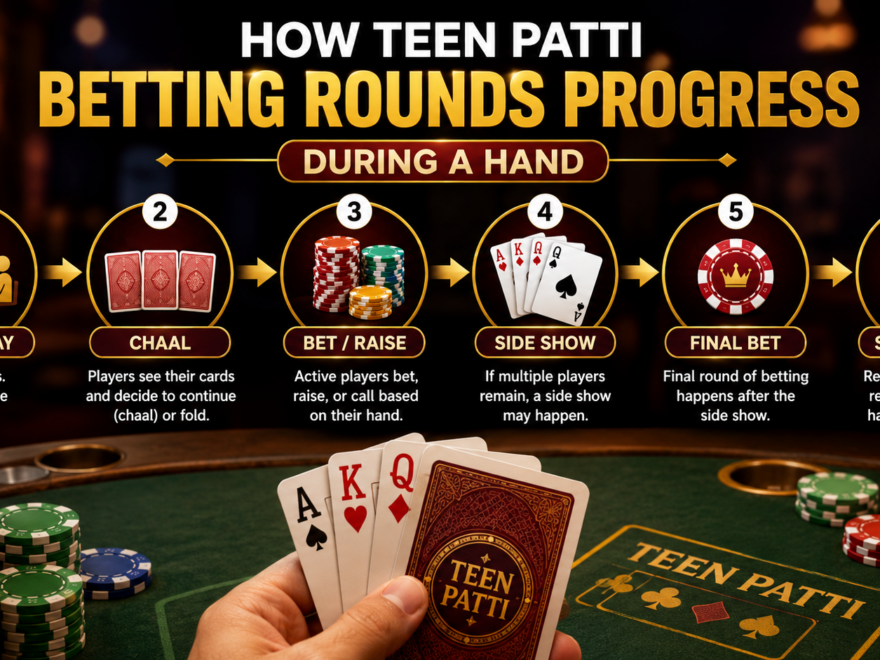
Teen Patti is a three-card card game where the action develops through a sequence of decisions rather than a fixed number of betting rounds. Every player receives three cards, but the cards are not the only thing that matters. Players must decide whether to remain blind, look at their cards, continue with a chaal, raise the stake, or pack and leave the hand.
Understanding how Teen Patti betting rounds progress makes the game much easier to follow. It also helps new players understand why the pot can grow quickly even though each player receives only three cards.
While rules can differ between tables and online platforms, the standard format follows a fairly clear flow from the initial boot to the final show.
Starting a Teen Patti Hand
Before the cards are dealt, players normally contribute a fixed starting amount known as the boot. This creates the initial pot and gives the hand something to play for.
Once the boot is collected, each active player receives three cards face down. At this stage, players have not necessarily seen their cards. The first important decision is whether to continue blind or check the cards and become seen.
The betting then moves from player to player, usually in a clockwise direction.
Blind Play Begins the Action
A player who has not looked at their three cards is called a blind player. Blind play adds uncertainty because the player is making decisions without knowing the strength of their hand.
In standard Teen Patti rules, the amount required from a blind player is generally linked to the current stake. The exact limits can vary according to the table or house rules, so players should always check the rules before starting.
For example, if the current stake is 10 chips, a blind player may be allowed to continue by placing an amount based on that stake. The next player’s required amount then changes according to the action taken.
This creates the first stage of the betting cycle.
Moving From Blind to Seen
A blind player can usually look at their cards when their turn arrives. Once they check their cards, they become a seen player.
Being seen changes the betting calculation. In many standard formats, a seen player has to put in a higher amount than a blind player. This difference is one of the most important parts of the Teen Patti betting structure.
For example, imagine four players are still active:
- Player A is blind.
- Player B is blind.
- Player C has seen the cards.
- Player D is blind.
Player C may face a higher required stake because they are playing seen. The exact amount depends on the current stake and the table’s rules.
The important point is that checking your cards changes how you participate in subsequent betting.
The Chaal Keeps the Hand Moving
The term chaal is commonly used for continuing with a bet after seeing the cards. During the betting sequence, players can generally continue, increase the stake within permitted limits, or pack.
A player who packs immediately leaves the hand. Any amount already contributed to the pot generally remains there, and the player no longer has a chance to win that pot.
This creates a simple cycle:
Bet → next player → continue or raise → next player → continue or pack
The cycle can repeat several times. There is not necessarily a fixed number of betting rounds like there is in some other card games. The hand continues as long as multiple players remain active and the table’s betting conditions allow further action.
Why the Pot Can Grow Quickly
The pot grows because each active player keeps contributing as the current stake changes.
Suppose three players remain after several folds. If one player increases the stake, the other active players must decide whether the larger commitment is worth making.
This is where Teen Patti becomes more than simply comparing three cards. The player must consider the strength of their own hand, the amount already invested, the behaviour of opponents and the increasing size of the pot.
A strong hand can justify continued participation, while a weak hand may not be worth chasing as the stake rises.
Folding Changes the Betting Round
Folding, often called pack, removes a player from the current hand.
For example, imagine five players start a hand. After several betting turns:
- Player A continues.
- Player B packs.
- Player C continues.
- Player D raises.
- Player E packs.
Only A, C and D remain active.
The betting continues between those players until another player folds or the hand eventually reaches a show.
This is why Teen Patti betting rounds are better understood as a continuous betting cycle rather than separate fixed rounds.
Side Show and Private Comparison
Some Teen Patti formats allow an eligible seen player to request a side show from another seen player. A side show is a private comparison between two eligible players.
The exact conditions for requesting or accepting a side show can vary between tables. Some formats do not allow it at all, while others restrict it to specific situations.
If a side show is available, it can change the number of players remaining without requiring the entire table to reveal their cards.
Because rules vary, players should check the specific format before assuming a side show is available.
When Does the Betting End?
A Teen Patti hand normally reaches one of two outcomes.
One Player Remains
If every other player packs, the last remaining player wins the pot. There is no need to reveal the cards because nobody else is still competing.
This is one of the reasons aggressive betting can influence the flow of a hand. A player does not always need the strongest possible cards to win if every opponent decides to fold.
Two Players Reach a Show
If two players remain and a show is called under the applicable rules, their cards are compared.
The winner is determined by the Teen Patti hand-ranking system. A standard ranking places Trail/Trio at the top, followed by Pure Sequence, Sequence, Color, Pair and High Card.
For example:
- Trail: A-A-A
- Pure Sequence: 9-8-7 of the same suit
- Sequence: 9-8-7 of mixed suits
- Color: three cards of the same suit without being consecutive
- Pair: K-K-5
- High Card: A-J-7 without another combination
The strongest eligible hand wins when the cards are compared.
A Simple Example of a Complete Betting Flow
Consider a table with four players: A, B, C and D.
Everyone first contributes the boot.
All four receive three face-down cards.
Turn 1: A stays blind and continues.
Turn 2: B looks at the cards and becomes seen.
Turn 3: C stays blind and continues.
Turn 4: D looks at the cards and continues as seen.
The betting returns to A. As the current stake changes, A must decide whether to continue or pack.
Suppose A folds. The hand now continues between B, C and D.
Later, C folds after the stake becomes too high. B and D are the final two players.
If a show is permitted and called, their cards are compared. The higher-ranking hand wins the pot.
This example shows how a single Teen Patti hand can move naturally from blind play to seen play, repeated chaal, folds and finally a show.
What Players Should Watch During Each Betting Turn
Following the action is easier when players pay attention to four things:
Current stake: Know how much is required to continue.
Player status: Keep track of who is blind, who is seen and who has packed.
Betting behaviour: Notice whether opponents are consistently calling, raising or folding.
Hand strength: If you have seen your cards, compare their strength with the possible hands in the ranking system.
For people looking for a platform that combines cricket, sports information and related online gaming categories, the Cricbet99 ID Provider is one relevant example to research. The platform itself states that availability and permitted activities can vary by location, so users should check applicable local rules and platform terms before participating.
Common Mistakes Beginners Make
One common mistake is assuming that every Teen Patti table follows exactly the same betting limits. House rules and online formats can differ.
Another mistake is forgetting that becoming seen can change the required betting amount.
Some beginners also keep calling simply because they have already put money into the pot. Previous contributions cannot be recovered by continuing a weak hand. A fresh decision should be based on the current situation.
Finally, players sometimes focus only on their own cards and ignore the betting pattern around the table. The progression of bets and folds is an important part of understanding the hand.
FAQs About Teen Patti Betting Rounds
How many betting rounds are there in Teen Patti?
Teen Patti does not normally use a fixed number of betting rounds. Players continue taking turns until everyone except one player folds or the hand reaches a permitted show.
What is the boot in Teen Patti?
The boot is the initial amount contributed by players before the cards are dealt. It forms the starting pot for the hand.
What is the difference between blind and seen?
A blind player has not looked at their cards. A seen player has checked their cards. Seen players generally face a higher betting requirement under standard rules.
What happens when a player packs?
A player who packs leaves the current hand and cannot win the pot. The amount already contributed normally remains in the pot.
When does a Teen Patti show happen?
A show generally occurs when only two players remain and the applicable rules allow one player to request a comparison. The two hands are then revealed and ranked.
Can Teen Patti rules vary?
Yes. Betting limits, side-show conditions, hand-order details and other rules can vary between tables, apps and house formats. Checking the specific rules before playing is important.
Final Thought
The progression of a Teen Patti hand is built around simple decisions that become more important as the stake increases. Starting with the boot, players move through blind or seen play, chaal, raises and folds before the hand ends with a last-player-standing result or a show.
Once the flow becomes familiar, it becomes much easier to understand why each betting turn matters. Beginners should first become comfortable with the difference between blind and seen play, the meaning of chaal and pack, and the basic hand-ranking order. Most importantly, rules can differ between platforms, so checking the table conditions before playing is always a sensible step.