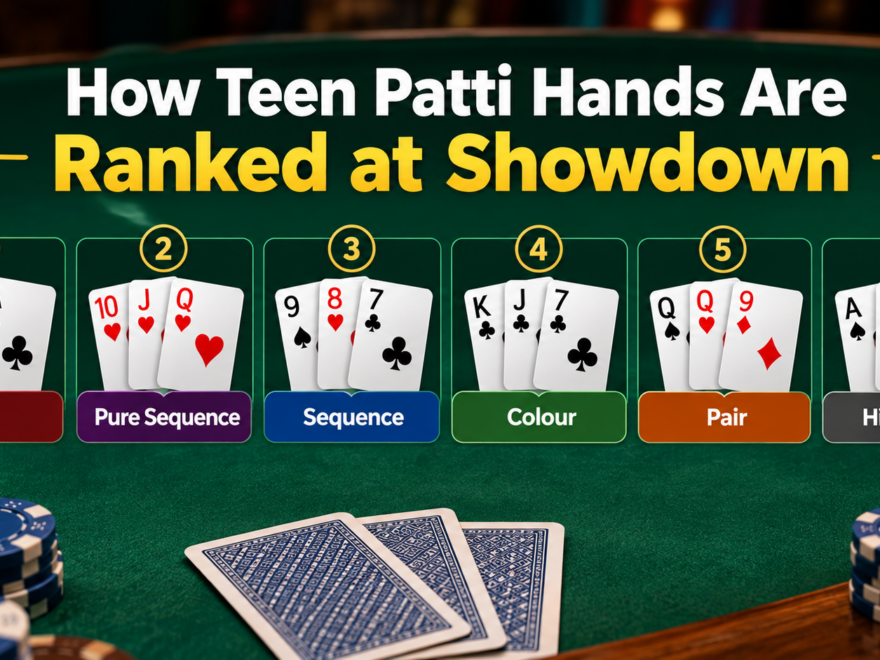
A showdown is one of the most important moments in a Teen Patti game. After the betting action is over and players reveal their cards, the winner is determined by comparing the strength of their three-card hands. Knowing how Teen Patti hands are ranked makes it much easier to understand why one player wins over another.
Teen Patti uses a different ranking system from traditional five-card poker. The game is based on three-card combinations, and the category of the hand is checked before individual card values. According to established Teen Patti rules, the usual order runs from Trail at the top to High Card at the bottom.
For players who want a clearer understanding of the game, knowing this ranking system is essential before getting involved in any serious betting decisions.
What Happens During a Teen Patti Showdown?
A showdown, commonly called a show, happens when the remaining players reveal their cards and compare them. The winner is the player holding the higher-ranking hand according to the applicable table rules.
The important point is that players do not simply compare their highest card. First, they identify the type of hand. Only when both players have the same type of hand do they move on to card-by-card comparisons.
For example, a player holding a Pair beats another player holding only a High Card, even if the High Card hand contains an Ace.
This simple principle prevents many common mistakes during a showdown.
Teen Patti Hand Rankings From Highest to Lowest
The standard ranking of Teen Patti hands is:
- Trail or Trio
- Pure Sequence
- Sequence
- Colour
- Pair
- High Card
A higher category beats every category below it. This means a Trail beats a Pure Sequence, while a Pair beats a High Card.
Let’s look at each hand in more detail.
1. Trail or Trio
A Trail, also called a Trio or Three of a Kind, is the strongest standard Teen Patti hand.
It consists of three cards with the same rank.
Examples:
- A-A-A
- K-K-K
- 8-8-8
Three Aces are generally considered the strongest Trail, while three Twos are the lowest Trail. When two players have Trails, the higher rank wins.
For example:
Player A: K-K-K
Player B: Q-Q-Q
Player A wins because Kings rank higher than Queens.
A Trail beats every other standard hand category.
2. Pure Sequence
A Pure Sequence consists of three consecutive cards from the same suit.
Examples include:
- 9-8-7 of hearts
- 7-6-5 of spades
- Q-J-10 of diamonds
It is stronger than a normal Sequence because the cards are both consecutive and suited.
Sequence conventions can differ between platforms and tables, particularly around Ace combinations such as A-2-3 and A-K-Q. Pagat’s traditional rules, for example, treat A-2-3 as the highest straight run.
Because of these variations, players should always check the specific rules before a game begins.
3. Sequence
A Sequence contains three consecutive cards, but the cards are not all from the same suit.
For example:
9♠ – 8♥ – 7♦
The ranks are consecutive, but the suits differ, so this is a normal Sequence rather than a Pure Sequence.
A Sequence beats Colour, Pair, and High Card, but it loses to a Pure Sequence and Trail.
When two players have Sequences, the relevant sequence ranking is compared according to the rules being used.
4. Colour
A Colour consists of three cards from the same suit that do not form a sequence.
For example:
A♥ – J♥ – 7♥
All three cards are hearts, but they are not consecutive.
Colour is below Sequence but above Pair and High Card.
When two Colours are compared, the highest card is checked first. If the highest cards are equal, the second card is compared, followed by the third if necessary. This card-by-card method is part of traditional Teen Patti hand comparison.
For example:
Player A: A♥-J♥-7♥
Player B: A♠-10♠-8♠
Both have Colour, and both have an Ace as their highest card. The second cards are then compared. Jack beats 10, so Player A wins.
5. Pair
A Pair contains two cards of the same rank and one different card.
Examples include:
- A-A-7
- K-K-4
- 9-9-A
A higher pair beats a lower pair.
For example:
A-A-5 beats K-K-A because the pair of Aces is stronger than the pair of Kings.
If both players have the same pair rank, the remaining card becomes important.
For instance:
Q-Q-K beats Q-Q-9
The pair is identical, so the third card decides the result.
6. High Card
High Card is the lowest standard Teen Patti hand. It occurs when the three cards do not form a Trail, Pure Sequence, Sequence, Colour, or Pair.
An example would be:
A♠ – J♥ – 7♣
There is no matching pair, no sequence, and no same-suit combination.
When two High Card hands meet, the highest card is compared first. If those cards are equal, the second-highest cards are compared, followed by the lowest cards if necessary.
How Tie-Breakers Work at Showdown
The easiest way to understand a showdown is to follow two steps:
Step 1: Compare the hand category.
A higher category wins immediately.
Step 2: If the categories are identical, compare card values.
For example:
| Player A | Player B | Winner |
| A-A-A | K-K-K | Player A |
| 9-8-7 same suit | 8-7-6 same suit | Player A |
| K-K-5 | Q-Q-A | Player A |
| A-J-7 same suit | A-10-9 same suit | Player A |
The important lesson is that the strongest individual card does not always determine the winner. The hand category comes first.
Common Showdown Mistakes
One of the biggest mistakes beginners make is assuming an Ace automatically means a strong hand. A-K-J, for example, is still only a High Card hand unless it qualifies as another combination under the applicable rules.
Another common mistake is confusing Colour with Pure Sequence. Three cards of the same suit are not automatically a Pure Sequence. They must also meet the required sequence pattern.
Players can also mistakenly apply poker rankings to Teen Patti. The two games do not use identical hand hierarchies, so learning the Teen Patti-specific ranking system is important.
For additional background on the traditional rules and betting structure, Pagat’s Teen Patti rules guide provides a useful independent reference.
Why Understanding Hand Rankings Matters
Knowing the ranking of Teen Patti hands does more than settle arguments at showdown. It helps players understand the relative strength of their cards before making decisions.
A Pair, for example, is stronger than High Card but remains below Colour, Sequence, Pure Sequence, and Trail. Understanding this hierarchy gives players a clearer picture of where their hand stands.
If you’re looking for a broader place to follow Teen Patti content, game information, and related betting topics, you can also visit CricBet99 for more gaming-focused content.
However, hand strength alone does not determine every outcome. Teen Patti also involves betting decisions, table dynamics, and uncertainty. Players should understand the rules of the specific table or platform before participating.
Frequently Asked Questions
What is the highest Teen Patti hand?
The Trail, also known as Trio or Three of a Kind, is the highest standard Teen Patti hand. Three Aces are generally the strongest Trail.
Does a Trail beat a Pure Sequence?
Yes. Under the standard Teen Patti hierarchy, a Trail ranks above a Pure Sequence.
What is the difference between Pure Sequence and Sequence?
A Pure Sequence contains three consecutive cards from the same suit. A normal Sequence contains consecutive cards that are not all from the same suit.
Does a Pair beat High Card?
Yes. Any standard Pair beats a High Card hand.
How are two Pairs compared?
The pair with the higher rank wins. If both players have the same pair, the remaining card is compared.
How are two Colour hands compared?
The highest card is compared first. If those cards are equal, the second-highest card is compared, followed by the third card if required.
Is A-2-3 always the highest Teen Patti sequence?
Not necessarily across every table or platform. Sequence rules, especially Ace combinations, can vary. Traditional rules such as those documented by Pagat treat A-2-3 as the highest straight run, while some platforms use different conventions. Always check the rules being used.
Final Thought
Understanding how Teen Patti hands are ranked during showdown makes the final stage of a game much easier to follow. The key is to remember the basic hierarchy: Trail, Pure Sequence, Sequence, Colour, Pair, and High Card.
Once the hand category is identified, compare the cards only when necessary. This approach removes much of the confusion around showdowns and helps players understand exactly why one hand defeats another.
Since individual platforms and house rules can vary, checking the applicable rules before playing is always a smart step. With the ranking system clear, even a complicated showdown becomes much easier to read.