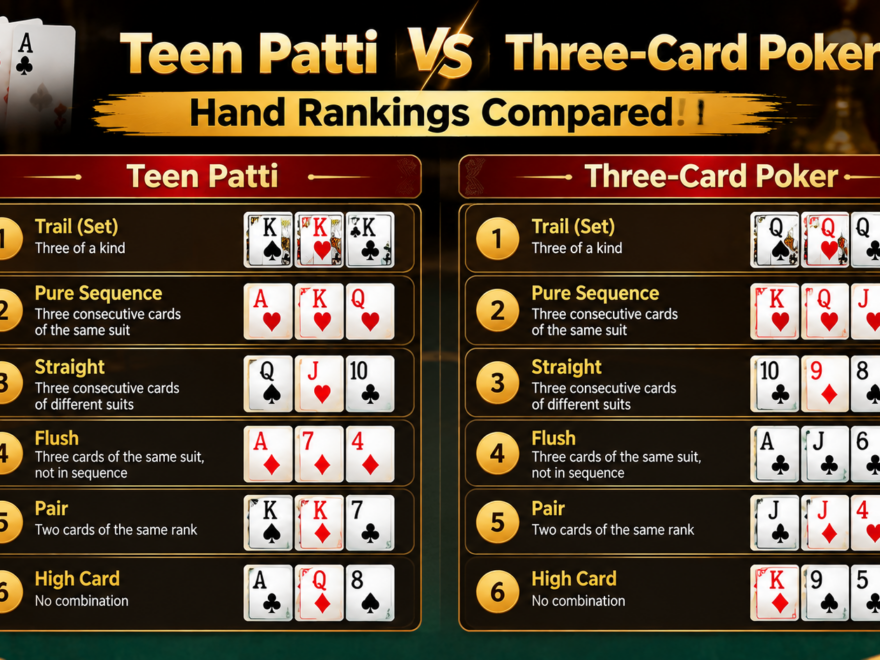
Teen Patti and Three-Card Poker both use three-card hands, but their ranking systems are not identical. This difference can surprise players who move from one game to the other, especially when comparing a straight, flush or three of a kind. Although the games share some familiar poker concepts, each follows its own hand-ranking rules and gameplay format.
Understanding Teen Patti card rankings alongside standard Three-Card Poker rankings helps players identify stronger combinations and avoid comparing hands incorrectly. Anyone interested in card-game formats can also visit Teen Patti games and guides on Cricbet99 for related gaming information.
What Is the Main Difference Between the Two Ranking Systems?
The most important distinction concerns the order of a straight and a flush.
In standard Teen Patti, a Sequence ranks above a Colour. A Sequence consists of three consecutive card ranks, while a Colour consists of three cards of the same suit that do not form a sequence.
In standard Three-Card Poker, a Flush ranks above a Straight. A Flush contains three cards of the same suit, while a Straight contains three consecutive ranks.
This reversal matters because a hand that wins against another combination in one game may lose to it in the other. Players should identify the game first and then apply the correct ranking system.
Teen Patti Hand Rankings From Highest to Lowest
Traditional Teen Patti uses six main hand categories. The usual order, from strongest to weakest, is as follows.
1. Trail or Trio
A Trail, also called a Trio, contains three cards of the same rank.
Example: A♠ A♥ A♦
Three Aces generally form the strongest Trail, while three Twos form the weakest. A Trail beats every other standard Teen Patti hand category.
2. Pure Sequence
A Pure Sequence consists of three consecutive cards of the same suit.
Example: 9♥ 8♥ 7♥
It is also known as a straight flush in poker terminology. In standard Teen Patti, a Pure Sequence ranks below a Trail but above an ordinary Sequence.
3. Sequence
A Sequence contains three consecutive ranks that are not all from the same suit.
Example: 9♠ 8♥ 7♦
This combination ranks below a Pure Sequence but above a Colour in traditional Teen Patti.
4. Colour
A Colour contains three cards of the same suit that do not form a sequence.
Example: A♣ J♣ 6♣
The highest card is normally compared first when two Colour hands compete. If the highest cards match, the next card is compared, followed by the third if necessary.
5. Pair
A Pair contains two cards of the same rank and one unrelated card.
Example: K♠ K♦ 8♥
The pair determines the hand’s primary strength. If two players have the same pair rank, the remaining card may determine the winner under the table’s tie-breaking rules.
6. High Card
A High Card hand does not qualify as a Trail, Pure Sequence, Sequence, Colour or Pair.
Example: A♠ J♦ 6♣
When two High Card hands are compared, the highest card is considered first, followed by the next highest and then the third.
Standard Three-Card Poker Hand Rankings
Standard casino Three-Card Poker generally uses a different hierarchy. From strongest to weakest, its main categories are:
- Straight Flush: Three consecutive cards of the same suit.
- Three of a Kind: Three cards of the same rank.
- Straight: Three consecutive cards, not all from the same suit.
- Flush: Three cards of the same suit that are not consecutive.
- Pair: Two cards of the same rank.
- High Card: A hand that does not qualify for any higher category.
A key detail is that standard Three-Card Poker places a Straight Flush above Three of a Kind. Traditional Teen Patti instead places a Trail above a Pure Sequence.
Side-by-Side Comparison of Hand Rankings
| Hand category | Traditional Teen Patti | Standard Three-Card Poker |
| Three of a kind | 1 | 2 |
| Straight flush / Pure Sequence | 2 | 1 |
| Straight / Sequence | 3 | 3 |
| Flush / Colour | 4 | 4 |
| Pair | 5 | 5 |
| High Card | 6 | 6 |
The table shows the usual category order, but one terminology detail is important: in Teen Patti, the top three-card combination is generally called a Trail or Trio, and its ranking is above a Pure Sequence. In standard Three-Card Poker, a Straight Flush is the highest category.
The relative position of Straight and Flush is also different: a Teen Patti Sequence outranks a Colour, whereas a standard Three-Card Poker Flush outranks a Straight. These differences make it essential to use the correct rules for each game.
Practical Examples: How the Same Cards Compare
Consider a hand containing 8♠ 7♠ 6♠. It is a Pure Sequence in Teen Patti and a Straight Flush in Three-Card Poker. It ranks strongly in both games, though its position relative to a three-of-a-kind hand differs.
Now consider 8♠ 7♥ 6♦. This is a Sequence in Teen Patti and a Straight in Three-Card Poker. In both games, it beats an ordinary non-consecutive three-card combination of the same general strength category, but the surrounding hierarchy differs.
Finally, take A♣ J♣ 4♣. This is a Colour in Teen Patti and a Flush in Three-Card Poker. In standard Teen Patti, a Sequence ranks above it. In standard Three-Card Poker, a Flush ranks above a Straight.
These examples show why recognising the combination is only the first step. The game’s ranking order determines which hand wins.
Common Mistakes Players Should Avoid
Assuming both games rank hands identically: Similar card combinations do not guarantee identical rankings.
Confusing a Sequence with a Pure Sequence: A Pure Sequence requires consecutive ranks and the same suit. Consecutive cards of mixed suits form an ordinary Sequence.
Ranking a flush too highly in Teen Patti: In traditional Teen Patti, a Sequence beats a Colour.
Forgetting the three-of-a-kind distinction: Teen Patti’s Trail outranks a Pure Sequence, while standard Three-Card Poker places a Straight Flush above Three of a Kind.
Ignoring house rules: Some Teen Patti variations change hand rankings or ace treatment. Always check the rules for the specific table or app.
Frequently Asked Questions
1. Is Teen Patti the same as Three-Card Poker?
No. Both games use three-card hands, but their rules, betting structures and hand rankings differ.
2. Does a Sequence beat a Colour in Teen Patti?
Yes. Under the usual traditional Teen Patti ranking, a Sequence ranks above a Colour.
3. Does a Flush beat a Straight in Three-Card Poker?
Yes. In standard Three-Card Poker, a Flush ranks above a Straight.
4. Which hand is the strongest in Teen Patti?
A Trail or Trio is generally the strongest hand category, with three Aces usually the highest Trail.
5. Can Teen Patti rankings vary between games?
Yes. Variations and house rules may change the ranking order, ace sequence rules or tie-breaking procedures. Check the rules before playing.
Final Thought
Teen Patti and standard Three-Card Poker may look similar because both use three-card hands, but their rankings should never be treated as interchangeable. The main differences include the position of a Trail relative to a Pure Sequence and the order of a Sequence and Colour compared with a Straight and Flush.
Learning the correct hierarchy makes hand comparisons clearer and reduces confusion when switching between games. Before joining a table, review its rules and confirm whether it follows traditional Teen Patti rankings or standard Three-Card Poker rules. If playing for money, set a budget and treat the game as entertainment rather than a source of income.