Teen Patti is a game where betting decisions can be just as important as the cards in your hand. Players can continue blind, become seen, raise the stake, pack, or eventually call for a show. But in a game with several players still involved, there is another interesting option: the Side Show.
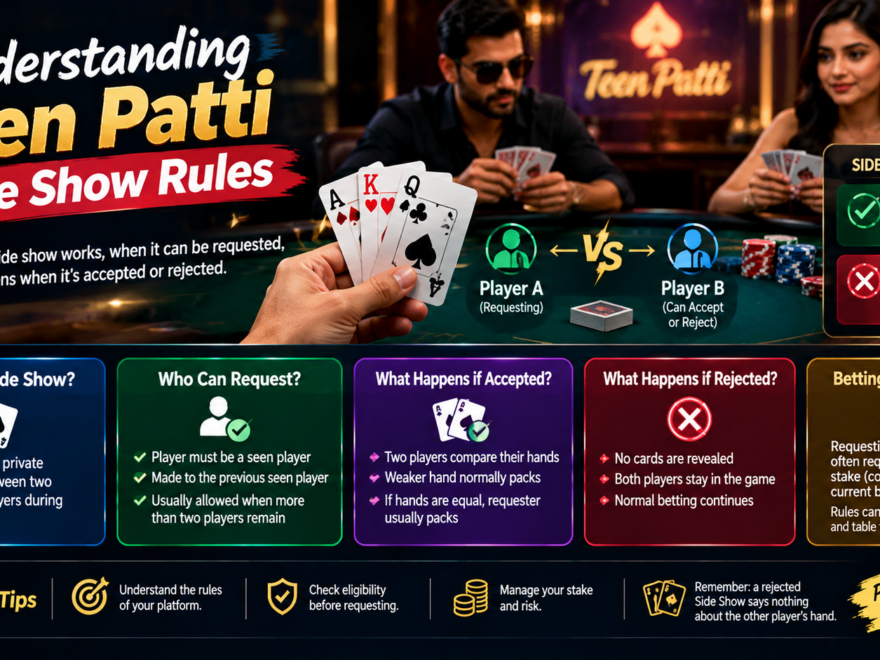
A Side Show allows one eligible player to privately compare their cards with another player during the round. The other player does not have to accept the request. They can accept it or reject it, depending on the rules of the table and the situation.
For anyone playing online Teen Patti, understanding this decision can make the game much easier to follow. The important point is that a Side Show is not the same as a final Show, and acceptance or rejection can change what happens next.
What Is a Side Show in Teen Patti?
A Side Show is a private comparison between two players who have already seen their cards.
In commonly used Teen Patti rules, the player requesting a Side Show generally needs to be a seen player, and the request is made to the player who acted immediately before them. The requested player can then either accept or decline the comparison.
If the request is accepted, the two players compare their cards privately. The player with the weaker hand normally has to pack and leave the current round. If the hands have the same ranking, many standard rule sets require the player who requested the Side Show to pack.
If the request is rejected, neither player’s cards are revealed and the round continues.
Who Can Request a Side Show?
The exact eligibility can vary between Teen Patti platforms, but the traditional format generally has a few conditions.
First, the player requesting the Side Show must have seen their cards. A blind player normally cannot request or be asked for a Side Show. Second, the other player must also be eligible under the particular table’s rules.
A commonly described rule set allows a Side Show when more than two players remain and the requesting player is seen. The request is directed toward the previous seen player who placed the relevant bet.
This means a player cannot simply choose any opponent at the table and demand a private comparison.
How Does Side Show Acceptance Work?
When a player accepts a Side Show, the two involved players privately compare their three-card hands.
The comparison does not normally reveal the cards to everyone else at the table. Instead, it is used to determine which of the two players continues.
For example, imagine three players remain:
- Player A has a strong hand.
- Player B has a medium-strength hand.
- Player C requests a Side Show against Player B.
If Player B accepts, the two hands are compared privately. If Player C has the stronger hand, Player B packs. If Player B has the stronger hand, Player C packs.
If the hands are equal, the standard rule used by several Teen Patti platforms is that the player who requested the Side Show must pack.
The Side Show therefore creates a direct risk for the player making the request.
What Happens When a Side Show Is Rejected?
Rejection is completely different from acceptance.
When a player declines a Side Show request, their cards are not revealed. The two players remain in the game, and normal betting continues according to the table’s rules.
A rejection does not automatically mean that the other player has a weak hand. There can be several reasons for declining the request.
A player might:
- Have a strong hand and want the betting to continue.
- Suspect that the requester is trying to eliminate them.
- Prefer not to reveal information.
- Want to keep pressure on the table.
- Follow a different strategy based on the current pot and betting level.
The important lesson is simple: a rejected Side Show does not prove anything about the opponent’s cards.
Is a Side Show Free?
In many commonly used Teen Patti rule sets, requesting a Side Show involves placing the required betting amount before the request is made. One widely documented version requires the seen player to pay twice the current stake for the Side Show request.
However, players should not assume that every online table uses exactly the same structure.
Different apps, private tables, and game variants can modify betting limits, eligibility, or Side Show availability. Always check the rules displayed by the specific platform before playing.
Side Show vs Final Show
The two terms sound similar, but they serve different purposes.
Side Show
A Side Show happens during the round while multiple players may still be active. It is a private comparison between eligible players.
Final Show
A Show is generally used when only two players remain. Their cards are revealed and compared to determine the winner of the pot.
This distinction is important because a Side Show usually eliminates one player while the round continues. A final Show, on the other hand, can determine the winner of the entire pot.
Why Would a Player Request a Side Show?
The decision can depend on the strength of the hand, betting pressure, number of players remaining, and the player’s overall approach to the round.
A player with a reasonably strong hand may request a Side Show to remove a particular opponent and reduce the number of active players.
But there is a downside. If the comparison goes against the requester, they can be the one forced to pack.
That makes the Side Show a risk-based decision rather than a guaranteed way to improve a player’s position.
Why Might a Player Reject It?
Acceptance and rejection can both be useful depending on the circumstances.
A player holding a strong hand might reject a Side Show because there is no reason to give the opponent a chance to eliminate them through a comparison.
Another player might reject simply because they prefer to continue betting without revealing any information.
Since rejection does not expose the cards, players should avoid treating it as a reliable signal about hand strength.
Common Mistakes With Side Shows
Assuming Rejection Means a Weak Hand
This is one of the biggest mistakes. A player can reject a Side Show with a strong hand or a weak hand.
Forgetting That Rules Can Vary
Different platforms may have different Side Show conditions, costs, or availability.
Confusing Side Show With Show
A Side Show is an intermediate comparison. A Show is generally the final comparison between the remaining players.
Ignoring the Cost
If the table requires an additional stake for a Side Show, the player should understand that cost before making the request.
Treating It as a Guaranteed Advantage
A Side Show does not guarantee that the requester will survive. The comparison can eliminate the requester instead.
Frequently Asked Questions
Can a blind player request a Side Show?
Under commonly used Teen Patti rules, no. Side Shows are generally available between eligible seen players.
Can the other player reject a Side Show?
Yes. In standard versions, the requested player can accept or reject the request. If rejected, the cards remain hidden and normal play continues.
What happens if a Side Show is accepted?
The two players privately compare their cards. The weaker hand normally packs. If the hands are equal, the requester may be required to pack under the applicable rules.
Does rejecting a Side Show mean the player has good cards?
No. Rejection alone does not reveal the strength of a player’s hand.
Is Side Show available in every Teen Patti game?
Not necessarily. Availability and conditions can differ between apps, tables, and game variants, so players should check the specific rules before starting.
What is the difference between Side Show and Show?
A Side Show is a private comparison during an ongoing round. A Show is normally the final comparison when only two players remain.
Final Thought
The Side Show is one of the most interesting decision points in Teen Patti because both acceptance and rejection can affect the direction of a round. Accepting puts the two hands directly against each other, while rejecting keeps the cards hidden and allows normal betting to continue.
The key is to understand that a Side Show is not simply a way to check whether another player has better cards. It comes with its own conditions, potential cost, and risk. The exact rules can also differ between platforms and variants.
For players interested in Teen Patti, understanding the difference between blind, seen, Side Show, rejection, acceptance, and final Show provides a much clearer picture of how a round develops. Most importantly, players should check the rules of the specific table before participating and keep their play within applicable local laws and responsible-gaming limits.