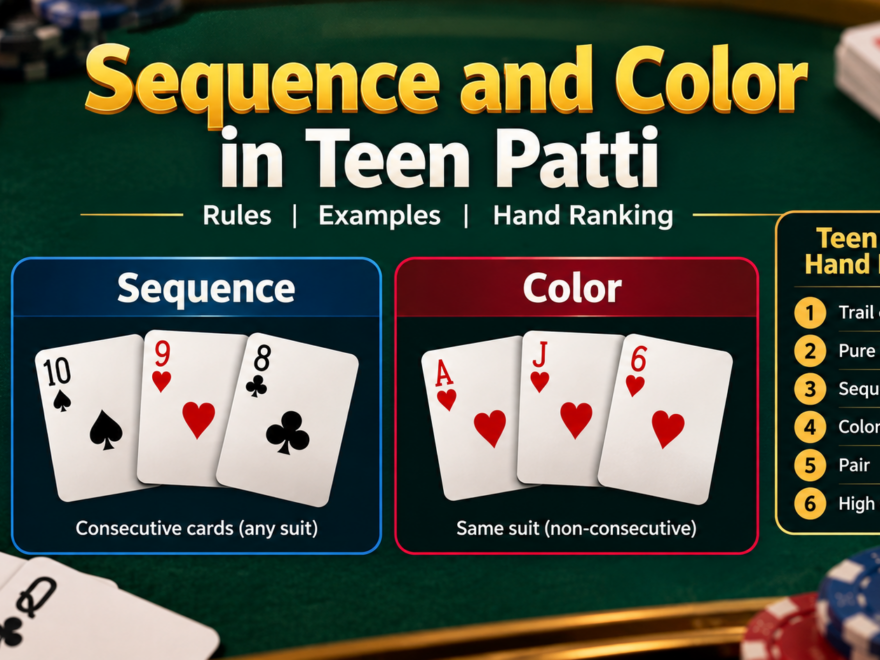
Teen Patti is one of the most familiar three-card card games in India, but knowing the basic rules is only the beginning. To understand how a hand can win or lose, players need to be comfortable with the Teen Patti hand rankings, especially the difference between a Sequence and a Color.
At first glance, these two hands can seem similar. Both can contain three different cards, and both can look strong during a game. However, their formation and position in the hand hierarchy are different. Understanding this distinction makes it easier to compare cards during a Show and avoid common mistakes.
For players who want to explore more card-game and gaming-related information, Cricbet99 also provides access to cricket, sports, live information and casino-related categories. Always check the rules applicable to your location and play responsibly.
What Is a Sequence in Teen Patti?
A Sequence in Teen Patti consists of three consecutive cards. The cards must follow a numerical or face-card order, but they do not necessarily need to belong to the same suit.
For example:
- 9♠ – 8♥ – 7♦
- K♣ – Q♥ – J♠
- 6♦ – 5♣ – 4♥
These hands qualify as Sequences because the card values follow a consecutive order.
A Sequence is also sometimes referred to as a straight or run. In the standard hand hierarchy, it ranks below a Pure Sequence but above a Color, Pair and High Card.
This is an important point for beginners because Teen Patti does not simply compare the highest individual card. The category of the complete three-card hand comes first.
What Is a Pure Sequence?
A Pure Sequence is stronger than an ordinary Sequence because the three consecutive cards also belong to the same suit.
For example:
9♥ – 8♥ – 7♥
This is a Pure Sequence because the cards are consecutive and all three are hearts.
Other examples include:
- Q♠ – J♠ – 10♠
- 7♦ – 6♦ – 5♦
- 5♣ – 4♣ – 3♣
The difference between a Sequence and Pure Sequence is therefore quite simple: a Sequence requires consecutive values, while a Pure Sequence requires consecutive values and the same suit.
Players should also remember that sequence conventions can vary between tables or platforms, particularly when an Ace is involved. Some rules place A-2-3 differently from A-K-Q, so checking the specific table rules is always a sensible step before playing.
What Is a Color in Teen Patti?
A Color, also known as a Flush in some descriptions, contains three cards from the same suit. Unlike a Pure Sequence, however, the cards do not have to be consecutive.
For example:
A♣ – J♣ – 6♣
All three cards are clubs, so the hand is a Color.
Other examples include:
- K♥ – 9♥ – 4♥
- Q♠ – 8♠ – 3♠
- 10♦ – 7♦ – 2♦
The important thing to remember is that the cards share the same suit but do not form a consecutive sequence.
This makes Color easy to confuse with Pure Sequence. The easiest way to remember the difference is:
Same suit + consecutive cards = Pure Sequence
Same suit + non-consecutive cards = Color
Sequence vs Color: Which Hand Is Higher?
In the standard Teen Patti ranking, a Sequence beats a Color.
The commonly used order from strongest to weakest is:
- Trail or Trio
- Pure Sequence
- Sequence
- Color
- Pair
- High Card
This means a mixed-suit Sequence such as 10♠-9♥-8♦ can beat a Color such as A♣-J♣-6♣.
This can surprise players who are more familiar with traditional poker rankings, where a flush has a different position. Teen Patti follows its own three-card ranking system, so learning the specific hierarchy is essential.
How Are Two Sequence Hands Compared?
If two players both have a Sequence, the strength of the sequence is compared.
For example:
Player A: Q-J-10
Player B: 9-8-7
Player A has the higher Sequence and would normally win.
The same principle applies when comparing Pure Sequences. However, Ace-related sequences can be treated differently under different rule sets, so players should always follow the ranking convention being used at their table.
How Are Two Color Hands Compared?
When two players have a Color, the highest card is generally compared first.
Consider:
Player A: A-J-6 of hearts
Player B: K-Q-10 of clubs
Player A has an Ace as the highest card, while Player B has a King. Therefore, Player A’s Color is stronger.
If both players have the same highest card, the next-highest card is compared. If that is also equal, the third card can determine the result.
This card-by-card comparison is useful because two Color hands can look almost identical while having different strengths.
Common Mistakes Beginners Make
One of the most common mistakes is assuming that any three cards from the same suit form a Pure Sequence. They do not. The cards must also be consecutive.
Another mistake is believing that Color automatically beats Sequence because all three cards share the same suit. In standard Teen Patti rankings, that is not the case. Sequence ranks above Color.
Players can also overlook the importance of house rules. Different versions of Teen Patti may use variations involving Aces, jokers, wild cards or tie-breaking. Checking the rules before starting is especially important when playing on an online platform.
Quick Way to Remember the Ranking
A simple memory shortcut is:
Trail → Pure Sequence → Sequence → Color → Pair → High Card
The first three categories are particularly important because beginners often confuse them.
Think of the difference this way:
- Trail: same rank
- Pure Sequence: consecutive + same suit
- Sequence: consecutive
- Color: same suit, but not consecutive
- Pair: two matching ranks
- High Card: none of the above
Once this order becomes familiar, comparing hands becomes much faster.
FAQs About Sequence and Color in Teen Patti
Is Sequence higher than Color in Teen Patti?
Yes. In the commonly used Teen Patti hierarchy, a Sequence ranks above a Color.
What is the difference between Sequence and Pure Sequence?
A Sequence contains three consecutive cards, while a Pure Sequence contains three consecutive cards from the same suit.
Does Color mean three cards of the same suit?
Yes. A Color contains three cards belonging to the same suit, but they do not need to be consecutive.
Can a Color beat a Pure Sequence?
No. A Pure Sequence is higher than a Color in the standard Teen Patti ranking.
How do you compare two Color hands?
Usually, compare the highest card first. If the highest cards are equal, compare the second-highest and then the third card if necessary.
Is A-2-3 always the highest Sequence?
Not necessarily. Ace sequence conventions can vary between Teen Patti tables and platforms. Check the specific rules before playing.
What is the easiest way to learn Teen Patti hands?
Start by memorising the six basic categories: Trail, Pure Sequence, Sequence, Color, Pair and High Card. Then practise identifying each category from sample three-card combinations.
Final Thought
Understanding Sequence and Color is one of the easiest ways to improve your basic Teen Patti knowledge. The key is not to judge a hand simply by how attractive the cards look. First identify the category, then compare the strength within that category.
Once the difference between a Pure Sequence, Sequence and Color becomes clear, hand comparisons become much more straightforward. Whether you are learning Teen Patti for casual games or exploring online card-game platforms, knowing the ranking system gives you a much stronger foundation.
As with any online gaming activity, players should check the applicable laws and platform rules in their location and maintain responsible playing habits.