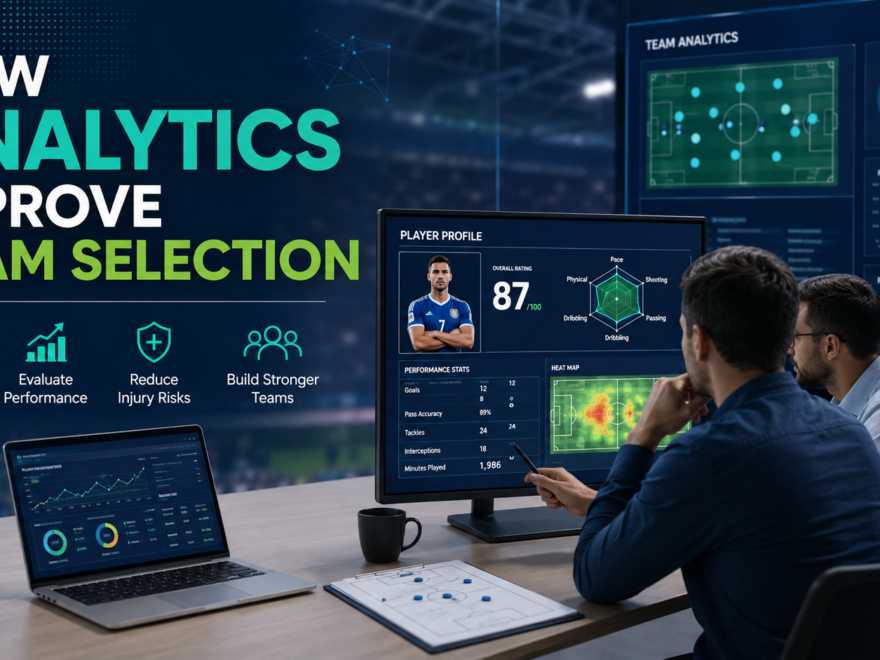
How Analytics Improve Team Selection in Modern Sports
In today’s competitive sports landscape, analytics has become one of the most powerful tools for building successful teams. What was once a process driven largely by intuition, experience, and traditional scouting has evolved into a data-driven strategy that helps coaches, managers, and executives make smarter decisions. From football and basketball to cricket and other professional sports, analytics is transforming how teams identify talent, evaluate performance, and select players.
As technology continues to advance, organizations are leveraging vast amounts of data to gain a competitive edge. The ability to analyze player performance, fitness levels, tactical strengths, and future potential has made analytics an essential component of modern team selection.
The Growing Role of Analytics in Sports
Sports analytics refers to the use of data, statistical models, and technology to evaluate players and improve decision-making. Teams now collect information from matches, training sessions, wearable devices, and video analysis systems to build comprehensive player profiles.
According to insights shared by the England Football Association’s partnership with Google Cloud, performance systems can process millions of data points to assess player fitness, form, and readiness for competition. This allows coaches to make informed decisions based on objective evidence rather than relying solely on observation.
Analytics helps teams answer critical questions such as:
- Which players are performing consistently?
- Who fits a specific tactical system?
- Which athletes have the highest potential for future growth?
- How can injury risks be minimized?
By using data to answer these questions, teams can improve both short-term performance and long-term success.
Improving Player Evaluation
One of the biggest advantages of analytics is its ability to enhance player evaluation.
Traditional scouting methods often focus on visible performance indicators such as goals scored, assists, or points accumulated. While these statistics remain important, they do not always provide a complete picture of a player’s contribution.
Modern analytics measures advanced metrics including:
- Efficiency ratings
- Passing accuracy
- Defensive impact
- Movement patterns
- Decision-making effectiveness
- Physical workload
For example, NBA teams increasingly use advanced metrics such as Player Efficiency Rating (PER), True Shooting Percentage, and Box Plus-Minus to assess overall player value. These measurements help organizations identify players whose contributions may not be immediately visible through conventional statistics.
This deeper level of analysis enables teams to discover undervalued talent and make more strategic recruitment decisions.
Making Better Draft and Recruitment Decisions
Analytics plays a major role during drafts, transfers, and recruitment processes.
Predictive models can analyze historical performance data to estimate a player’s future development. Rather than focusing only on current achievements, teams can identify athletes with strong growth potential.
Data-driven scouting reduces uncertainty and helps organizations avoid costly mistakes. By comparing thousands of performance indicators, teams can evaluate whether a player is likely to succeed within a specific system or environment.
Organizations also use platforms like the Google Cloud Data Analytics Solutions ecosystem to process and visualize large datasets, enabling faster and more accurate decision-making.
Enhancing Team Chemistry and Tactical Fit
Selecting the most talented players does not always create the best team.
Analytics helps coaches understand how individual players interact with one another. By studying passing networks, positioning data, and communication patterns, teams can determine which combinations produce the strongest results.
Advanced network analysis tools allow coaches to evaluate:
- Ball movement efficiency
- Team connectivity
- Player influence within tactical systems
- Collaboration effectiveness
This information helps decision-makers create balanced squads where individual strengths complement one another.
Instead of building teams around star power alone, organizations can focus on creating cohesive units capable of executing specific game plans.
Reducing Injury Risks Through Data
Injuries can significantly impact a team’s performance. Analytics helps minimize these risks by monitoring player health and workload.
Wearable technology and GPS tracking systems collect real-time information on:
- Distance covered
- Sprint intensity
- Recovery rates
- Heart rate patterns
- Training load
Sports science teams use this information to identify warning signs of fatigue and overtraining.
The England Football Association has implemented data-driven health monitoring systems that help coaches adjust training programs and optimize player readiness. This proactive approach allows teams to protect key athletes while maintaining peak performance throughout a season.
For more information on sports performance tracking, resources from the FIFA Technical Development Program provide valuable insights into modern athlete management.
Supporting Real-Time Selection Decisions
Analytics is not only useful before a season begins; it also supports real-time decision-making.
Coaches now have access to live performance data during matches and training sessions. This information helps them evaluate:
- Current player form
- Match fitness
- Tactical effectiveness
- Opponent weaknesses
As a result, selection decisions can be adjusted based on current performance rather than reputation alone.
Teams can identify which players are most likely to succeed against specific opponents and make strategic lineup changes accordingly.
This level of precision gives organizations a significant competitive advantage.
The Future of Analytics in Team Selection
The future of team selection will become even more data-driven as artificial intelligence, machine learning, and predictive modeling continue to evolve.
Emerging technologies will allow teams to:
- Predict player performance with greater accuracy
- Personalize training programs
- Optimize tactical strategies
- Improve injury prevention
- Enhance talent identification
As more organizations invest in analytics departments and advanced technologies, data will become increasingly central to every stage of team management.
Successful teams will likely be those that combine human expertise with data-driven insights to make smarter decisions.
FAQs
What is sports analytics?
Sports analytics is the process of collecting and analyzing data to improve decision-making related to player performance, team strategy, recruitment, and overall organizational success.
How does analytics help team selection?
Analytics helps teams evaluate player performance, predict future potential, identify tactical fit, and reduce bias in decision-making.
Can analytics replace traditional scouting?
No. Analytics works best when combined with traditional scouting. Data provides objective insights, while scouts contribute experience, context, and qualitative evaluation.
How do professional teams collect player data?
Teams use video analysis, GPS trackers, wearable devices, performance software, and statistical databases to gather information about athletes.
Which sports use analytics the most?
Basketball, football, baseball, cricket, soccer, and rugby are among the sports that heavily utilize analytics for team selection and performance improvement.
Final Thoughts
Analytics has fundamentally changed how teams select players and build winning squads. By combining advanced data analysis with traditional expertise, organizations can make more informed decisions, reduce risk, and maximize performance. Whether identifying emerging talent, improving team chemistry, or managing player health, analytics provides valuable insights that help teams stay ahead of the competition. As technology continues to evolve, data-driven team selection will become even more influential in shaping the future of sports.