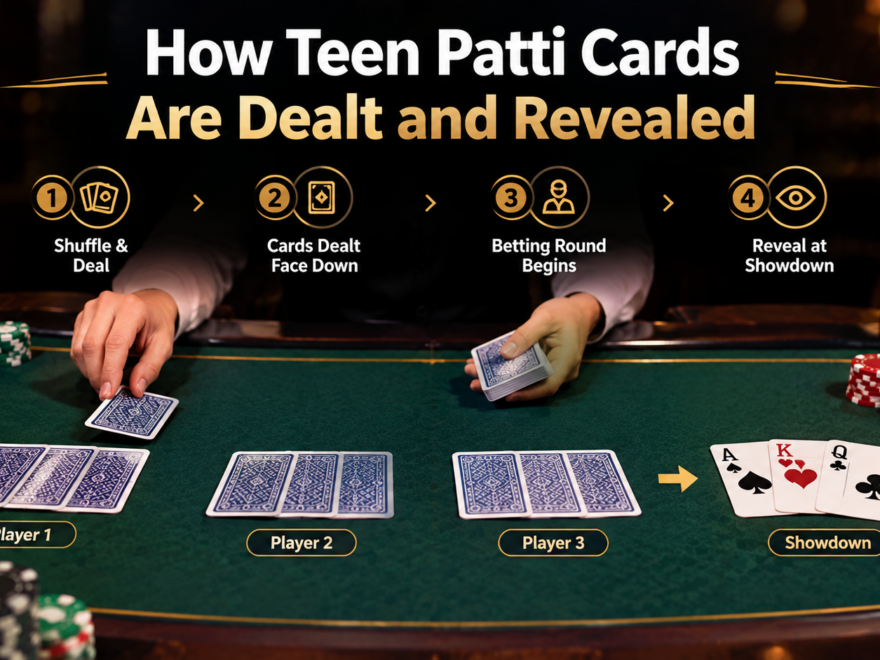
Teen Patti is a three-card game that has become a familiar part of card-game culture in India and beyond. The basic idea is easy to understand: players receive three cards, place bets during the round, and eventually compare their hands when a showdown takes place. However, the way those cards are dealt and revealed plays an important role in keeping the game organised.
For someone new to the game, understanding the dealing process can make the entire round easier to follow. It also explains why players can make decisions without immediately showing their cards to everyone else.
The traditional version of Teen Patti uses a standard 52-card deck, with each player receiving three cards. The cards are normally dealt one at a time rather than giving all three cards to one player before moving to the next.
How the Teen Patti Deal Begins
Before dealing starts, players normally agree on the initial stake or ante. This creates the starting pot that players compete for during the hand.
The dealer then shuffles the deck and begins distributing cards. In the traditional dealing sequence, each player receives one card before the next card is dealt around the table.
The process continues until everyone has three cards.
For example, if four players are sitting at a table, the first round of dealing gives each player one card. A second card then goes to each player, followed by a third card. At the end of the process, every player has a three-card hand.
This method keeps the deal organised and ensures that cards are distributed consistently.
Why Cards Are Usually Dealt Face Down
Teen Patti is based heavily on incomplete information. Players generally do not know what cards their opponents are holding, which creates uncertainty during betting.
For this reason, the cards are dealt face down.
Each player can hold their three cards without immediately revealing the hand to the rest of the table. Traditional Teen Patti allows players to participate either blind, without looking at their cards, or seen, after looking at their cards.
This distinction can affect the betting process.
A blind player continues without seeing their cards, while a player who looks at their cards becomes a seen player. The exact betting rules can vary between versions of Teen Patti, so players should check the rules of the particular table or platform.
What Does Playing Blind Mean?
Playing blind is one of the features that makes Teen Patti different from many familiar card games.
A blind player has received their cards but chooses not to look at them. They continue participating based on the betting situation rather than the strength of their known cards.
This does not mean that the cards are revealed to everyone else. The cards remain face down, and the player simply chooses not to inspect them.
Traditional rules describe blind and seen play as two different ways of participating in the betting round.
The choice creates an interesting element of uncertainty because a player may continue betting without knowing whether their hand contains a strong combination or a weak one.
When Does a Player See the Cards?
A player who starts blind can generally choose to look at their cards when their turn to act arrives, depending on the rules being used.
Once the cards are viewed, the player becomes a seen player.
This transition is important because traditional Teen Patti rules can apply different betting requirements to blind and seen players. In the standard rules described by Pagat, seen players generally have to bet more than blind players relative to the current stake.
However, online Teen Patti platforms can use different rule sets or formats. The displayed table rules should therefore be treated as the final reference for that particular game.
How the Cards Stay Hidden During Betting
After receiving three cards, players normally keep them concealed while betting continues.
This creates a natural separation between the dealing stage and the revealing stage.
During the betting stage, opponents may have no direct knowledge of each other’s cards. They have to make decisions based on their own hand if they have seen it, the betting behaviour of other players, and the rules of the game.
The cards are not normally turned face up after every betting action. Instead, they remain hidden until the hand reaches a point where a comparison is required.
That is what makes the eventual reveal meaningful.
What Happens When Players Fold?
Not every hand reaches a showdown.
As betting continues, players can decide to fold according to the applicable rules. A player who folds leaves the current contest and does not take part in the final comparison.
If enough players fold and only one player remains, that player can win the pot without necessarily having to reveal their cards. Traditional Teen Patti rules describe this as one of the ways a hand can end.
This means a strong hand is not always required to win a round. The betting process itself can determine the outcome when everyone else leaves the hand.
How the Final Reveal Works
When a hand reaches a showdown, the remaining players reveal their three-card hands.
The cards are then compared according to the hand-ranking system used by that version of Teen Patti.
Traditional Teen Patti rankings generally place three of a kind at the top, followed by a straight run, normal run, colour, pair, and high card.
For example, three cards of the same rank form a trio or trail. Three consecutive cards of the same suit form a straight run, while a pair consists of two cards with the same rank.
Because only three cards are involved, the reveal can happen quickly once the betting has finished.
Why the Reveal Is Important
The reveal is more than simply turning cards face up. It confirms the information that was hidden throughout the betting stage.
Imagine two players remain at the end of a round. Neither player’s cards have been visible to the other. Once the showdown begins, both hands are exposed and compared.
If one hand ranks higher according to the applicable rules, that player wins the pot.
This creates the final connection between the hidden information, betting decisions, and actual result of the hand.
How Online Teen Patti Handles Card Dealing
Online Teen Patti replaces the physical deck with digital card-dealing technology.
Instead of a dealer physically shuffling cards, software determines the card sequence and distributes virtual cards to the players. Many online platforms use a Random Number Generator, or RNG, as part of this process.
Cricbet99’s existing explanation of online Teen Patti describes RNG technology as the system used to generate random card sequences and distribute cards digitally.
For players considering Teen Patti games, the online experience can therefore look different from a physical table while retaining the same basic three-card concept. The interface usually displays cards directly on the screen and indicates when betting begins, when actions are available, and when the result is revealed.
Physical vs Online Card Reveals
The biggest difference between physical and online Teen Patti is the way the cards are presented.
At a physical table, players hold or look at actual cards. In an online game, the cards appear through the game’s interface.
The underlying sequence can still follow the same basic structure:
- The game begins.
- Cards are distributed to each player.
- Players receive three cards.
- Cards remain hidden from opponents.
- Betting takes place.
- Players may fold during the round.
- A showdown occurs if required.
- Remaining hands are revealed and compared.
The exact sequence can change in different Teen Patti variations, but this provides a useful overview of the traditional format.
Different Teen Patti Variations Can Change the Reveal
Not every game carrying the Teen Patti name follows exactly the same rules.
Some versions introduce special cards, side bets, different betting limits, or alternative ways of determining the winner. Live casino versions can also differ from traditional multiplayer Teen Patti because players may compete against the house rather than directly against other players.
Pagat notes that live casino Teen Patti can use a format similar to Three Card Poker, with the house acting as the opponent and additional betting options potentially being available.
For this reason, players should always check the rules displayed for a particular table before starting.
Frequently Asked Questions
How many cards does each Teen Patti player receive?
Each player normally receives three cards. In the traditional format, the cards are dealt one at a time until everyone has three.
Are Teen Patti cards dealt face up?
No. Traditional Teen Patti deals cards face down, allowing players to keep their hands private during the betting round.
What does playing blind mean in Teen Patti?
Playing blind means continuing in the game without looking at the three cards that have been dealt to you.
When are Teen Patti cards revealed?
Cards are normally revealed when a hand reaches a showdown. If all opponents fold, the remaining player may win without needing to reveal their cards.
What happens if two players have the same hand?
The method for resolving ties can depend on the specific Teen Patti rules being used. Players should check the rules of the particular game or platform.
Is online Teen Patti dealt in the same way as physical Teen Patti?
The presentation is different, but many online formats retain the basic three-card structure. Digital systems distribute the cards through software rather than a physical dealer.
Does every Teen Patti variation use the same rules?
No. Different variations can introduce changes to dealing, betting, hand rankings, side bets, or the way the final result is determined.
Final Thought
The dealing and revealing of cards are two of the simplest parts of Teen Patti, but they form the foundation of the entire round. Each player receives three cards, keeps them hidden during the betting stage, and reveals them only when the rules require a comparison.
The blind and seen formats add another layer to the process by allowing players to decide whether they want to act without looking at their cards. Meanwhile, online versions use digital dealing systems to recreate the same basic three-card structure on a screen.
Once players understand when cards are dealt, when they remain hidden, and when they are finally revealed, the flow of a Teen Patti round becomes much easier to follow. As with any card game, the exact rules can vary, so checking the rules of the specific format before playing is always important.