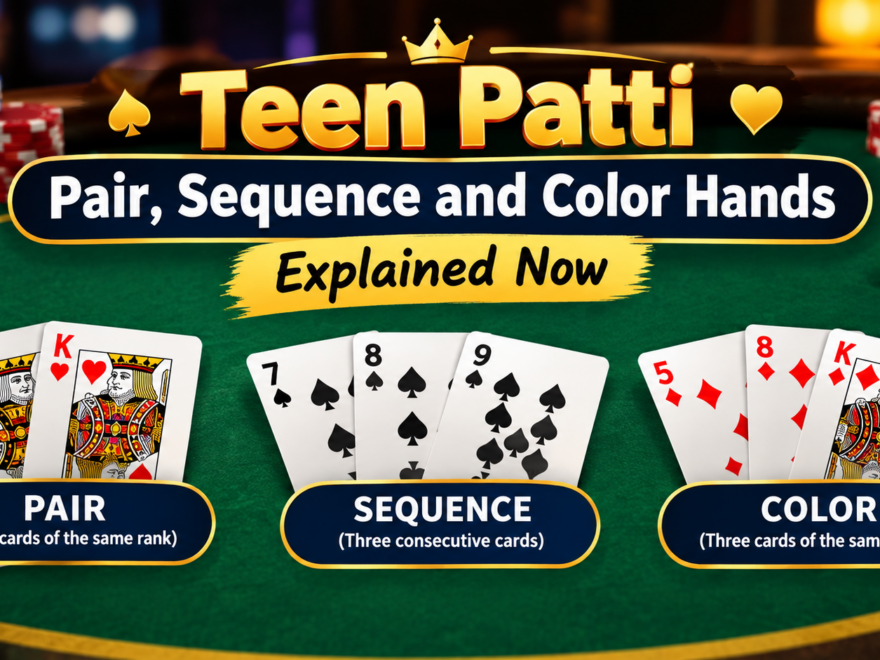
Teen Patti is a three-card game where understanding hand strength is just as important as knowing how the betting rounds work. Once the cards are dealt, players need to identify whether they have a Pair, Sequence, Color, or another recognised hand before deciding how to continue.
For beginners, Pair, Sequence, and Color can sometimes be confusing because all three hands have different structures and rankings. A Sequence is based on consecutive card values, a Color is based on cards sharing the same suit, while a Pair requires two cards of the same rank.
Knowing these differences makes it easier to compare hands during a show and understand why one hand beats another.
What Are Teen Patti Hand Rankings?
In the commonly used Teen Patti ranking system, hands are compared from strongest to weakest. The standard order is Trail, Pure Sequence, Sequence, Color, Pair, and High Card. Therefore, a Sequence beats a Color, while a Color beats a Pair.
For this article, the focus is on three important categories:
- Sequence: Three consecutive cards that are not all from the same suit.
- Color: Three cards from the same suit that are not a sequence.
- Pair: Two cards of the same rank plus one different card.
The category is identified first. Only after both players have the same category do the relevant card values become important.
Understanding a Teen Patti Pair
A Pair consists of two cards with the same rank and a third card of a different rank.
For example:
- A-A-7
- K-K-4
- 10-10-A
- 8-8-Q
The suits do not need to match for a Pair. What matters is that two cards have the same value.
Pair ranks below Color, Sequence, Pure Sequence, and Trail, but it is stronger than a High Card hand.
How Is a Pair Compared?
When two players both have Pairs, the first thing to compare is the value of the pair.
For example:
Player A: K-K-5
Player B: 9-9-A
Player A has the stronger Pair because Kings rank higher than Nines.
If both players have the same pair, the remaining card becomes important.
For example:
Player A: Q-Q-8
Player B: Q-Q-6
Both players have a pair of Queens, so the third card is compared. The Eight makes Player A’s hand higher.
This is an important point for beginners: the highest card in the hand does not automatically decide a Pair comparison. The pair itself is considered first.
What Is a Teen Patti Sequence?
A Sequence contains three consecutive card values. The cards do not all belong to the same suit.
Examples include:
- 9-8-7 in mixed suits
- Q-J-10 in mixed suits
- 6-5-4 in mixed suits
- A-K-Q in mixed suits
A Sequence is stronger than a Color, Pair, or High Card under the standard ranking system.
The important difference between a Sequence and a Pure Sequence is the suit. A Pure Sequence has three consecutive cards from the same suit, while a normal Sequence does not have all three cards in one suit.
Sequence Example
Consider these two hands:
Player A: 10-9-8, mixed suits
Player B: A-K-5, same suit
Player A has a Sequence, while Player B has a Color. Under the standard Teen Patti ranking, the Sequence wins because Sequence ranks above Color.
This can seem surprising to people familiar with other card games, so remembering the Teen Patti-specific ranking is important.
What Is a Teen Patti Color?
A Color consists of three cards from the same suit that are not consecutive.
For example:
- A-J-6 of Hearts
- K-9-4 of Spades
- Q-8-3 of Clubs
The cards must share the same suit, but they should not form a Sequence.
A Color is stronger than a Pair and High Card, but weaker than a Sequence, Pure Sequence, and Trail.
How Do You Compare Two Color Hands?
When two players both have a Color, compare the highest card first.
For example:
Player A: A-J-6 of the same suit
Player B: K-Q-9 of the same suit
Player A wins because an Ace is higher than a King.
If the highest cards are equal, compare the next highest card.
For example:
Player A: A-J-7
Player B: A-10-9
Both begin with an Ace, so the second card is compared. Jack is higher than Ten, giving Player A the higher Color.
If the first two cards are also equal, the third card can decide the comparison according to the applicable table rules.
Sequence vs Color vs Pair
A simple comparison can make the ranking easier to remember.
| Hand | Basic Requirement | Ranking |
| Sequence | Three consecutive cards, not all same suit | Higher |
| Color | Three cards of the same suit, not consecutive | Middle |
| Pair | Two cards of the same rank | Lower |
This means a Sequence beats a Color, and a Color beats a Pair.
For example, a mixed-suit 7-8-9 Sequence beats an Ace-high Color, because the hand category comes before the individual high card.
Similarly, a Color beats a Pair even if the Pair contains an Ace as its third card.
Why Hand Category Comes First
One of the most common beginner mistakes is comparing individual cards before identifying the hand category.
Suppose one player has:
A-9-4 of the same suit
and another player has:
10-9-8 in mixed suits
The first hand contains an Ace, but it is a Color. The second hand is a Sequence. Under the standard ranking, the Sequence wins.
This demonstrates why players should first ask, “What type of hand is this?” before comparing individual cards.
Sequence Rules and Ace Order
Ace combinations can sometimes cause confusion in Teen Patti. Common rule sets recognise sequences such as A-2-3 and A-K-Q, but their exact order can vary between rule sets or platforms. Pagat’s rules, for example, place A-2-3 above A-K-Q and do not treat 2-A-K as a valid sequence.
Because Teen Patti has multiple variations, players should always check the specific rules of the table or platform before relying on an Ace sequence.
This is particularly important in online games where a variation may use its own ranking convention.
Common Mistakes Beginners Make
A few simple mistakes can make hand comparison confusing.
Mistake 1: Assuming Color beats Sequence
Some players expect a same-suit hand to be stronger, but standard Teen Patti rankings place Sequence above Color.
Mistake 2: Looking only at the highest card
An Ace does not automatically beat a lower-category hand. The hand category comes first.
Mistake 3: Confusing Color with Pure Sequence
Three cards of the same suit are not automatically a Pure Sequence. They also need to be consecutive.
Mistake 4: Ignoring the Pair value
When two players have Pairs, compare the paired rank first, followed by the remaining card when required.
Mistake 5: Assuming every platform uses identical rules
Teen Patti has different variations, so table-specific rules should always be checked before playing.
Players interested in different Teen Patti games can therefore benefit from checking the specific hand-ranking and game rules before starting a session.
Frequently Asked Questions
Is a Sequence stronger than a Color in Teen Patti?
Yes. Under the commonly used ranking system, a Sequence ranks above a Color.
Is a Color stronger than a Pair?
Yes. A Color ranks above a Pair in the standard Teen Patti hierarchy.
What is a Pair in Teen Patti?
A Pair contains two cards of the same rank and one different card, such as A-A-7 or K-K-4.
How is a Pair compared between two players?
The higher pair wins. If both players have the same pair, the remaining card is compared according to the applicable rules.
What makes a Color?
A Color contains three cards of the same suit that do not form a consecutive sequence.
What makes a Sequence?
A Sequence contains three consecutive card values that are not all from the same suit.
Is A-2-3 always the same rank everywhere?
Not necessarily. Teen Patti variations and platforms can use different rules for Ace sequences, so checking the table rules is recommended.
Final Thought
Understanding Pair, Sequence, and Color is one of the most useful steps for anyone getting familiar with Teen Patti. The key is to identify the hand category first and compare individual card values only when the hands belong to the same category.
Remember the basic relationship: Sequence beats Color, and Color beats Pair. Once this order becomes familiar, hand comparisons become much easier and the difference between these three important Teen Patti hands is far clearer.