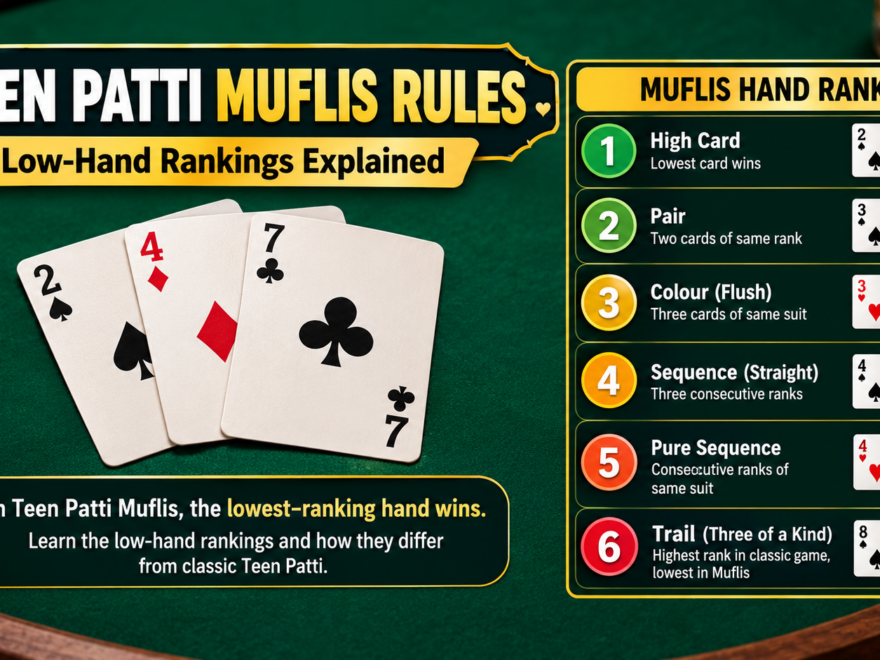
Teen Patti is traditionally played with the goal of forming the strongest possible three-card hand. However, some variations turn this familiar objective upside down. Teen Patti Muflis is one such variation, where the lowest-ranking hand wins instead of the highest. This reversal changes how players evaluate cards, compare combinations, and make decisions during a betting round.
For anyone familiar with classic Teen Patti, Muflis offers a different way to understand the game without changing its basic three-card structure. Knowing the ranking system and checking the rules before playing can help avoid confusion, particularly when different tables follow different interpretations.
What Is Teen Patti Muflis?
Muflis is a low-hand variation of Teen Patti in which the usual hand-ranking order is reversed. A combination that would normally be considered powerful may become a disadvantage, while an ordinary high-card hand can become the preferred outcome.
The game generally retains familiar elements such as three face-down cards, blind and seen play, betting rounds, and a final show. The main difference lies in how hands are evaluated.
Before joining a table, players should confirm whether it uses a complete reversal of traditional hand rankings or a different low-card system. Rules concerning aces, sequences, colours, and tied hands can vary between platforms and house rules.
How Teen Patti Muflis Rules Work
Although the ranking system changes, the basic gameplay usually follows the traditional Teen Patti format.
- Agree on the rules: Confirm the boot amount, betting limits, hand rankings, and any special conditions.
- Deal the cards: Each player receives three face-down cards from a standard deck.
- Begin betting: Players take turns deciding whether to continue as blind or seen players, where permitted.
- Continue or fold: Players can make the required bet or pack, depending on the table rules.
- Compare hands: When a show is called under the applicable rules, the remaining hands are compared using the Muflis ranking system.
- Determine the winner: The player with the winning low hand takes the pot, subject to the agreed rules.
Understanding this process makes it easier to separate the familiar betting structure from the unusual hand-comparison system.
Teen Patti Muflis Hand Rankings Explained
In a commonly used full-reversal version, the traditional ranking categories are arranged in the opposite order. The following table illustrates that format, from the preferred category to the least favourable.
| Muflis ranking | Hand type | Example |
| 1 — Best | High Card | 2♠ 4♦ 7♣ |
| 2 | Pair | 3♠ 3♦ 8♣ |
| 3 | Colour (Flush) | 3♥ 6♥ 9♥ |
| 4 | Sequence (Straight) | 4♠ 5♦ 6♣ |
| 5 | Pure Sequence | 4♥ 5♥ 6♥ |
| 6 — Worst | Trail (Three of a Kind) | 8♠ 8♦ 8♣ |
This table follows the full-reversal model, rather than every possible Muflis variant. A particular table may handle sequences, aces, or ties differently, so its displayed rules should take precedence.
1. High Card
A high-card hand contains three cards that do not form a pair, sequence, or flush. Under the full-reversal model, this is the strongest category in Muflis.
For example, a mixed-suit hand of 2, 4, and 7 is generally preferable to a high-card hand containing a King, Queen, and 9. The lower values make the first hand more favourable under this comparison method.
2. Pair
A pair consists of two cards with the same rank and one unrelated card. While pairs are useful in classic Teen Patti, they rank below high-card hands in the full-reversal Muflis format.
For example, a pair of 3s is better within the pair category than a pair of Kings, assuming lower ranks are preferred and the table follows standard reversed comparisons.
3. Colour and Sequences
A colour, also called a flush, contains three cards of the same suit. A sequence contains three consecutive ranks, while a pure sequence combines consecutive ranks of the same suit.
These combinations can be strong in conventional Teen Patti, but their relative position changes in a full-reversal Muflis game. Players should not assume that a visually impressive combination is automatically favourable.
4. Trail
A trail, also known as three of a kind, consists of three cards of the same rank. It is the highest category in classic Teen Patti but the lowest category in the full-reversal Muflis ranking.
This is one of the most important differences to remember when switching between the two formats.
How Are Low Hands Compared?
In the common full-reversal format, players first compare the hand categories. If both hands belong to the same category, card values are compared using the relevant low-hand rules.
Consider this example:
- Player A: 2♠ 4♦ 7♣
- Player B: 3♣ 5♥ 8♦
Both hands are high-card combinations. Player A has the lower highest card, 7, compared with Player B’s 8. Therefore, Player A wins under this comparison method.
If the highest cards match, the next-highest cards are compared, followed by the remaining card when necessary. Exact ties must be resolved according to the table’s rules.
Ace treatment deserves particular attention. Some formats treat an ace as low, while others use different conventions, especially for sequences. Never assume that A-2-3 has the same status in every Muflis game.
Common Mistakes to Avoid
Applying classic Teen Patti rankings: Remember that Muflis reverses the objective in the full-reversal format. A trail is no longer the best category.
Ignoring table-specific rules: Different versions may treat sequences, colours, aces, and ties differently. Read the rules before the first round.
Comparing only the smallest card: A single low card does not automatically make a hand the winner. The hand category and remaining card values may also matter.
Confusing hand rankings with betting decisions: A favourable hand does not guarantee a win. Other players’ decisions, the remaining cards, and the betting structure all affect the round.
For a broader introduction to related formats, see this Teen Patti variations guide, which provides a natural starting point for exploring the game and its different rule structures.
For additional background on traditional three-card hand rankings and gameplay, consult Pagat’s Teen Patti rules guide. Use the rules published for your particular Muflis table when they differ from the standard game.
FAQs About Teen Patti Muflis
1. What is the main rule of Teen Patti Muflis?
The main rule is that the lowest-ranking hand wins in the common Muflis format. Traditional hand rankings are reversed, although exact rules can vary between tables.
2. Which hand is best in Muflis?
Under the full-reversal ranking system, a high-card hand is the best category. Among comparable high-card hands, lower card values are preferred.
3. Is a trail good in Teen Patti Muflis?
A trail is usually the least favourable category under full-reversal rules. This is the opposite of classic Teen Patti, where three of a kind is the strongest category.
4. Is an ace always considered low in Muflis?
No. Ace rules can differ between versions, particularly when sequences are involved. Check the table’s rules before playing.
5. Does Muflis use the same betting process as classic Teen Patti?
Generally, yes. Dealing, blind and seen play, betting, folding, and show procedures often remain similar. However, specific betting and show conditions depend on the table.
Final Thought
Teen Patti Muflis offers a fresh perspective on a familiar card game by changing the way hands are ranked. Instead of automatically valuing pairs, sequences, and trails, players must understand the low-hand hierarchy and compare combinations according to the active rules.
The most useful starting point is to learn the ranking categories, practise comparing example hands, and confirm the treatment of aces and ties before playing. Clear rule knowledge makes the format easier to follow, while responsible play helps keep the experience enjoyable. No hand-ranking system can guarantee a win, and outcomes remain uncertain.