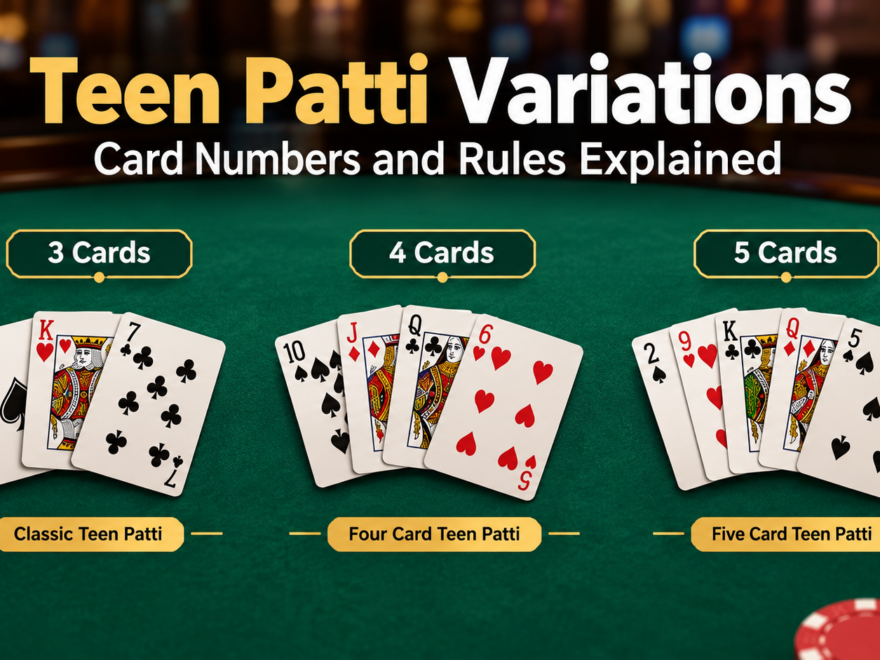
Teen Patti is a popular card game known for its simple format, quick rounds, and different ways to play. In the classic version, every player receives three cards. However, some variations introduce extra cards, shared cards, or different ways to form a winning hand. These changes can make the same game feel completely different.
Understanding the number of cards used in each variation is a useful first step for beginners. It helps players recognise the rules, compare hand combinations, and avoid confusion when switching between formats.
How Many Cards Are Used in Classic Teen Patti?
Classic Teen Patti uses a standard 52-card deck without jokers. Each active player receives three face-down cards, and the aim is to finish with the strongest hand or encourage other players to fold.
The usual hand rankings, from strongest to weakest, are:
- Trail: Three cards of the same rank, such as three Kings.
- Pure Sequence: Three consecutive cards of the same suit.
- Sequence: Three consecutive cards of different or mixed suits.
- Colour: Three cards of the same suit that are not consecutive.
- Pair: Two cards of the same rank.
- High Card: A hand that does not form any of the combinations above.
These rankings provide the foundation for many Teen Patti variations. However, some versions change the ranking order or allow certain cards to act as wild cards. For the standard rules and gameplay details, readers can refer to Pagat’s Teen Patti rules guide.
1. Classic Teen Patti: Three Cards Per Player
Classic Teen Patti is the easiest format to understand because every player receives exactly three cards. Players decide whether to continue betting blind, play after viewing their cards, or fold according to the table rules.
With only three cards in hand, each card can make a meaningful difference. A pair may look promising, but a sequence or trail ranks higher under standard rules.
The number of cards does not change during the round. Players compare their three-card combinations when a show takes place, following the agreed rules.
Main difference: Every player receives three private cards, and the standard hand-ranking system determines the stronger combination.
2. Best-of-Four Teen Patti: Four Cards to Choose From
Best-of-Four is a variation in which each player receives four cards but must select the best three-card hand from them.
This extra card creates more possible combinations. For example, a player might receive a pair alongside a card that helps form a sequence. Having four cards gives that player more options when choosing which three cards to use.
The key point is that the final hand is still made up of three cards. The fourth card provides flexibility rather than automatically increasing the final hand size.
However, the exact selection rules and hand rankings should be checked before playing because variations can differ between tables and platforms.
Main difference: Players receive four cards but use the best three, where the rules permit this format.
3. Five-Card Teen Patti Variations: More Cards, Different Rules
Some Teen Patti-style variations deal five cards to each player. These versions can use different rules for deciding which cards count toward the final hand.
In certain formats, players must select three cards from their five-card hand. In others, the game may introduce special combinations, wild cards, or a different ranking system.
For instance, a five-card variation might give a player more opportunities to form a strong three-card combination. Yet extra cards do not guarantee a winning hand. The result still depends on the specific rules and the cards available.
It is important not to assume that every five-card version works the same way. Some games use a different objective altogether, even if they share the Teen Patti name.
Main difference: Players may receive five cards, but the number used to determine the result depends on the variation’s rules.
4. Community-Card Variations: Private and Shared Cards
Community-card formats introduce another way to change the card structure. Instead of receiving every card directly into a private hand, players may receive private cards while some cards are placed face-up for everyone to use.
In a three-card community format, a player might receive two private cards and use one shared card to form a three-card hand. Some five-card community formats deal additional shared cards, with the final selection depending on the table rules.
This structure differs from classic Teen Patti because players must consider both their own cards and the shared cards available to everyone.
Main difference: The final hand may combine private cards with community cards rather than relying only on privately dealt cards.
Quick Comparison of Teen Patti Card Variations
| Variation | Cards dealt or available | Main difference |
| Classic Teen Patti | 3 private cards | Uses the standard three-card hand |
| Best-of-Four | 4 private cards | Select the best 3, where allowed |
| Five-card variation | 5 private cards | Final hand depends on the specific rules |
| Community-card format | Private plus shared cards | Players build a hand using available community cards |
This comparison is a general guide, not a universal rulebook. A game’s title alone may not explain its exact dealing or selection rules.
Do More Cards Make Teen Patti Easier to Win?
Not necessarily. Extra cards can provide more combinations to consider, but they can also change how strong a hand needs to be. A pair that seems useful in classic Teen Patti may have a different practical value in a variation with wild cards or altered rankings.
Players should check three things before starting:
- The number of cards dealt: Know how many cards each player receives.
- The final hand requirement: Check whether all cards count or only a selected combination.
- The hand-ranking rules: Confirm whether standard rankings apply or the variation changes them.
For anyone comparing online formats, it is also useful to review the rules and conditions displayed for the specific game. Readers interested in broader gaming options can visit Teen Patti and other live casino games to see the site’s relevant gaming category.
FAQs
How many cards are dealt in classic Teen Patti?
Each player receives three face-down cards from a standard 52-card deck, usually without jokers.
What is Best-of-Four Teen Patti?
In this variation, players receive four cards and select the best three-card hand, according to the version’s rules.
Are there five-card Teen Patti variations?
Yes. Some versions deal five cards or introduce community cards. The exact way players form their final hands depends on the specific format.
Do Teen Patti hand rankings stay the same in every variation?
No. Many variations retain the usual rankings, but others change them through wild cards or alternative systems. Always check the rules first.
Does receiving more cards guarantee a stronger hand?
No. Extra cards create more possible combinations, but the outcome depends on the cards dealt, the rules, and the hands held by other players.
Final Thought
Teen Patti variations differ not only in their names but also in how cards are dealt and used. Classic Teen Patti uses three cards, Best-of-Four provides an extra card for selection, and certain five-card or community-card formats introduce additional ways to build a hand. Understanding these differences makes it easier to follow the game and avoid mistakes. Before joining any table, check its card count, hand rankings, and specific rules so you know exactly how that version works.