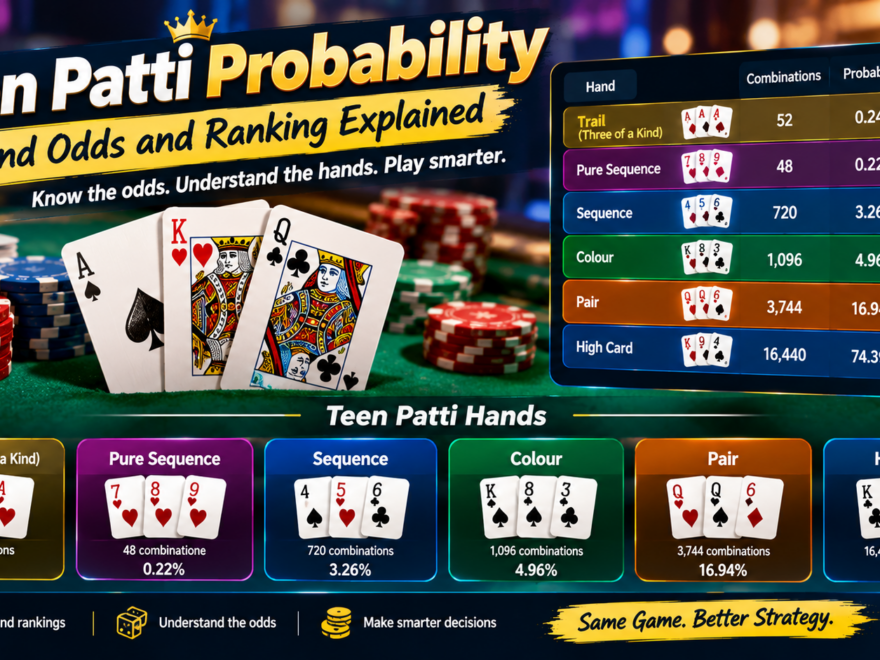
Teen Patti is a popular three-card game where understanding hand rankings and probability can make every decision more informed. Although the game involves luck, knowing how frequently different hands appear helps players understand why some combinations are much stronger and rarer than others.
Many beginners focus only on receiving a high-ranking hand. However, understanding the odds of getting a Trail, Pure Sequence, Sequence, Colour, Pair, or High Card provides a clearer picture of the game. For anyone interested in Teen Patti, learning these basic probability concepts is a useful starting point.
This guide explains the mathematics behind common Teen Patti hands, how the odds compare, and why probability should be treated as a guide rather than a prediction.
How Does Teen Patti Probability Work?
In standard Teen Patti, each player receives three cards from a standard 52-card deck without jokers. The total number of unique three-card combinations is 22,100.
This number comes from the combination formula:
52C3 = 22,100
Because the order of the three cards does not matter, combinations are counted rather than different dealing sequences. Each possible hand belongs to one of six standard categories.
The probability of receiving a particular hand is calculated by dividing the number of combinations that form that hand by 22,100, then multiplying by 100 to get a percentage.
For example, a Pair appears in 3,744 possible combinations. This gives it a probability of approximately 16.94%.
Teen Patti Hand Rankings and Probability Table
The following figures apply to the standard three-card version without jokers. Some regional games and online variations may use different rules, so always check the specific table’s hand-ranking instructions.
| Hand | Combinations | Probability | Approximate Frequency |
| Trail (Three of a Kind) | 52 | 0.24% | 1 in 425 |
| Pure Sequence | 48 | 0.22% | 1 in 460 |
| Sequence | 720 | 3.26% | 1 in 31 |
| Colour | 1,096 | 4.96% | 1 in 20 |
| Pair | 3,744 | 16.94% | 1 in 6 |
| High Card | 16,440 | 74.39% | About 3 in 4 |
The table highlights an important point: High Card hands are extremely common, while premium combinations such as Trails and Pure Sequences occur much less frequently. These figures describe the chance of being dealt each hand, not the probability of winning against a particular opponent.
Understanding the Odds of Each Teen Patti Hand
1. Trail: The Strongest Standard Hand
A Trail, also called a Trio or Three of a Kind, contains three cards of the same rank. Examples include three Aces or three Sevens.
There are only 52 possible Trail combinations in a standard deck, giving the hand a probability of approximately 0.24%. In other words, it appears about once in every 425 deals on average.
Its rarity explains its high position in the usual hand-ranking order. However, a Trail is not guaranteed to win money because the final result also depends on the other players’ cards and betting decisions.
2. Pure Sequence: Three Consecutive Cards of the Same Suit
A Pure Sequence consists of three consecutive cards belonging to the same suit. For example, 7, 8, and 9 of hearts form a Pure Sequence.
There are 48 combinations of this type, producing a probability of approximately 0.22%. This makes it slightly less common than a Trail under the standard probability model.
The exact order of certain Ace sequences can depend on the game’s rules. Players should confirm the accepted sequence rankings before joining a table.
3. Sequence: Consecutive Cards in Different Suits
A Sequence contains three consecutive cards that do not all share the same suit. For example, a 4 of hearts, 5 of clubs, and 6 of diamonds form a Sequence.
This hand has 720 possible combinations and a probability of approximately 3.26%, or around one in 31 deals.
A Sequence ranks below a Pure Sequence but above a Colour in the usual Teen Patti ranking system.
4. Colour: Three Cards of the Same Suit
A Colour consists of three cards from the same suit that do not form a sequence. For instance, a King, 8, and 3 of spades can make a Colour.
There are 1,096 such combinations, giving the hand a probability of approximately 4.96%.
Although a Colour is more common than a Sequence, it usually ranks below one. This is an important difference for players who are familiar with five-card poker, where the relative ranking of flushes and straights follows a different system.
5. Pair: Two Cards of the Same Rank
A Pair contains two cards of the same rank and one card of another rank. Examples include two Queens with a 6 or two Fives with a King.
Pairs appear in 3,744 combinations, making them relatively common at approximately 16.94%.
When two players have Pairs, the higher pair generally wins. If the pairs have the same rank, the remaining card can determine the result under standard rules.
6. High Card: The Most Common Hand
A High Card hand has no pair, sequence, or three cards of the same suit. Examples include a King, 9, and 4 from different suits and in no consecutive order.
High Card represents approximately 74.39% of all possible combinations. That means nearly three out of every four randomly dealt hands fall into this category.
When two players have High Card hands, their cards are compared from highest to lowest according to the applicable rules.
How Can Players Use Probability in Teen Patti?
Probability is most useful when it helps players set realistic expectations. Since strong hands are rare, waiting for a premium combination every round is not a practical way to approach the game.
Consider these principles:
- Understand hand strength: Learn the standard rankings before making decisions.
- Avoid chasing rare hands: A Trail may be powerful, but its low probability does not mean it is due to appear soon.
- Check the rules: Joker games and other variations can change the possible combinations and their probabilities.
- Set spending limits: Decide how much you can afford to spend before playing and avoid increasing it to recover losses.
It is also important to distinguish the probability of being dealt a hand from the probability of winning. Opponents’ cards, the number of players, betting patterns, and game rules all affect the outcome.
For additional mathematical background, combinatorics and probability explain how combinations can be counted in card games and other situations.
Common Mistakes When Calculating Teen Patti Odds
One frequent mistake is assuming that every hand has an equal chance of appearing. The probability table shows that High Card combinations are far more common than premium hands.
Another mistake is treating average frequency as a fixed schedule. A Trail appearing approximately once in 425 deals does not mean one must appear within the next 425 hands. Each deal is a separate event when cards are freshly shuffled and dealt under standard conditions.
Players can also misapply probabilities from other card games. Teen Patti uses three cards, so five-card poker statistics cannot be used directly. Different versions involving jokers or special wild-card rules require separate calculations.
FAQs About Teen Patti Probability
What is the probability of getting a Trail in Teen Patti?
In the standard 52-card game without jokers, a Trail has 52 possible combinations out of 22,100, giving a probability of approximately 0.24%.
Which Teen Patti hand appears most often?
High Card is the most common hand, occurring in approximately 74.39% of all possible three-card combinations.
Is a Pure Sequence rarer than a Trail?
Yes. A Pure Sequence has 48 combinations, compared with 52 for a Trail. Its probability is approximately 0.22%, compared with 0.24% for a Trail.
Do Teen Patti probabilities change when jokers are used?
Yes. Joker rules introduce additional possible combinations and can change hand frequencies and rankings. The standard probability table should not be applied directly to these variations.
Can probability guarantee a win in Teen Patti?
No. Probability describes how frequently outcomes can occur over many deals. It cannot predict a specific hand or guarantee a winning result.
Final Thought
Understanding Teen Patti probability makes the game’s hand rankings easier to interpret. The mathematics shows why High Card hands are common, Pairs appear regularly, and premium combinations such as Trails and Pure Sequences are rare.
The most useful approach is to combine knowledge of hand rankings with a clear understanding of the rules and realistic expectations. Probability can explain the likelihood of receiving a particular combination, but it cannot remove uncertainty from the game.
Play responsibly, set limits before participating, and remember that no probability chart can guarantee a profit.